

Wild Dojo Strike
By pressing play, you agree that you are above legal age in your jurisdiction and that your jurisdiction allows online gambling.

Wild Dojo Strike
RTP96.27%
VolatilityMedium
Max winx12,000
Lines20
Hit rate35.33%
ReleasedApr 2024

Ninja Cats Turn the Dojo Wild
Wild Dojo Strike puts three color-coded ninja cats to work across a 5×4 grid with 20 fixed paylines.
From Bullshark Games, Wild Dojo Strike is a medium volatility slot with 96.27% RTP and 12,000x maximum win potential for line-play fans. I staked $200.00 across 100 regular $2.00 spins, received $54.40, triggered 13 respin starts, and never reached Free Spins. You can play Wild Dojo Strike free in demo mode on SatoshiHero: You can also play Wild Dojo Strike online for real on SatoshiHero.
Key Takeaways
- Best bonus: Regular base-game spins were my only tested mode, so no purchase deserves a best-value label.
- Best play: Extreme Wild Dojo Spins offers the richest starting setup, but I didn’t test its $400.00 cost.
- RTP / volatility: The theoretical return is 96.27%, paired with medium volatility.
- Max win: The 12,000x cap pays immediately and ends the round when reached.
- Risk note: My test lost $145.60, while the direct bonus entries cost 100x and 200x the base stake.

Table of Contents
- How Wild Dojo Strike Works
- Red Wild, Multiplier Wilds
- Theme and First Impressions
- Wild Dojo Spins
- Orange Wild, Sticky Wilds
- How the 100 Spins Played
- Purple Wild, Expanding Wilds
- RTP, Volatility and Our Test
- The Simulator Projection
- Our 100-Spin Session
- Frequently Asked Questions
- The Takeaway
How Wild Dojo Strike Works
This is a traditional 5×4 slot with 20 fixed paylines. Wins begin on reel one and cross adjacent reels from left to right, usually with three matching symbols. You aren’t dealing with clusters, pay-anywhere rules, or shifting Megaways. Controls stayed clear when I changed screen sizes, which matters when you track colors before every spin.
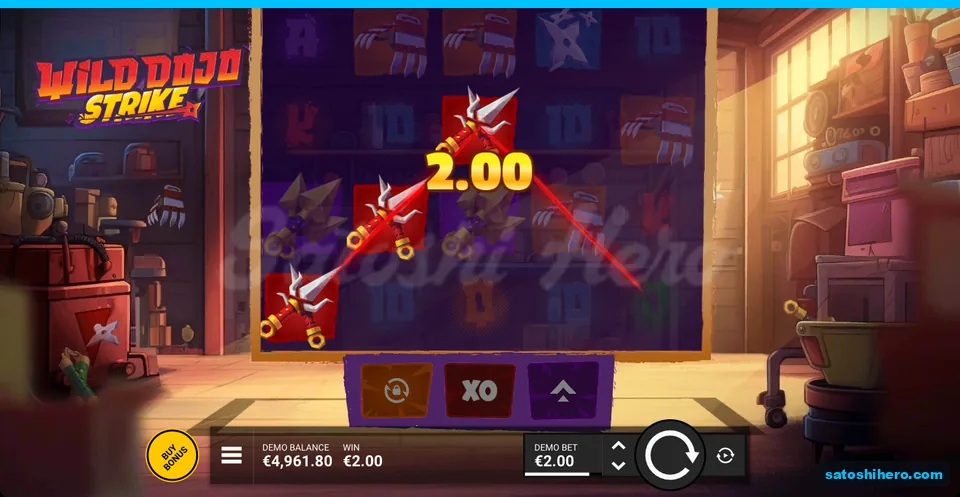
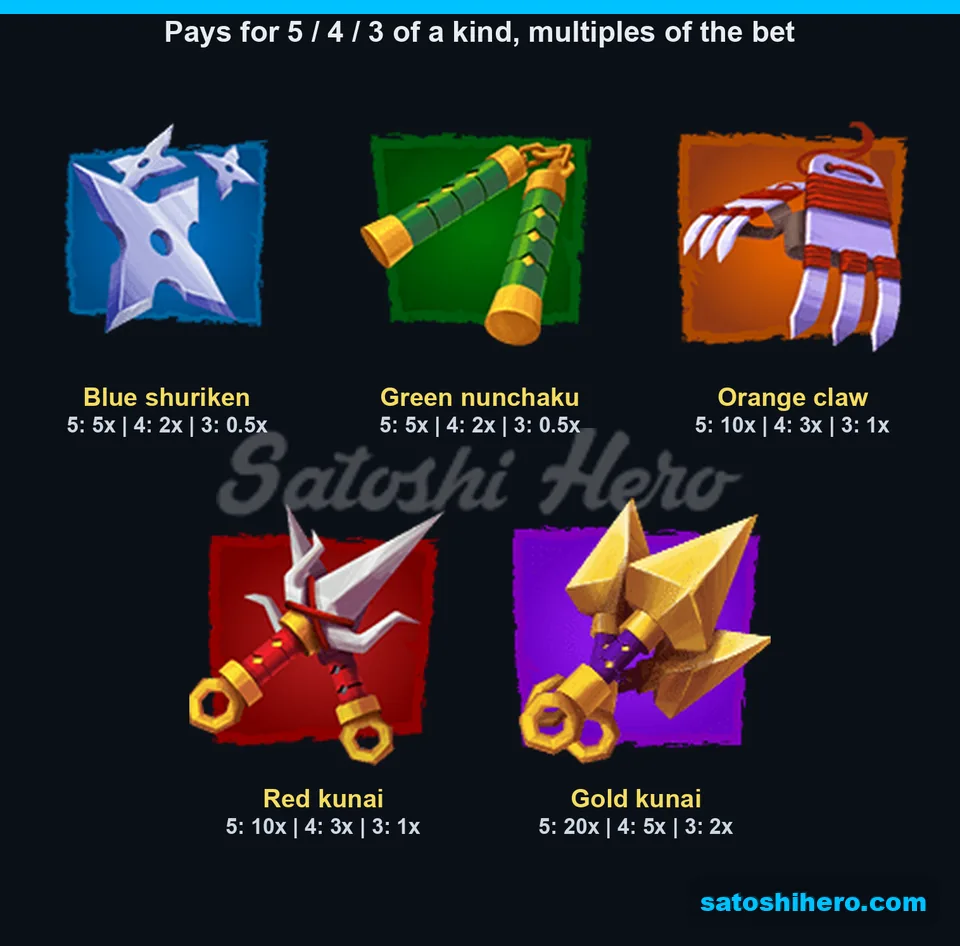
Blue shuriken and green nunchaku pay 5x, 2x, or 0.5x for five, four, or three. Orange claws and red kunai pay 10x, 3x, or 1x, while gold kunai pay 20x, 5x, or 2x. My three red kunai returned $2.00 from a $2.00 stake, confirming that 1x entry. I like this direct paytable because you can verify ordinary line hits without mental gymnastics.
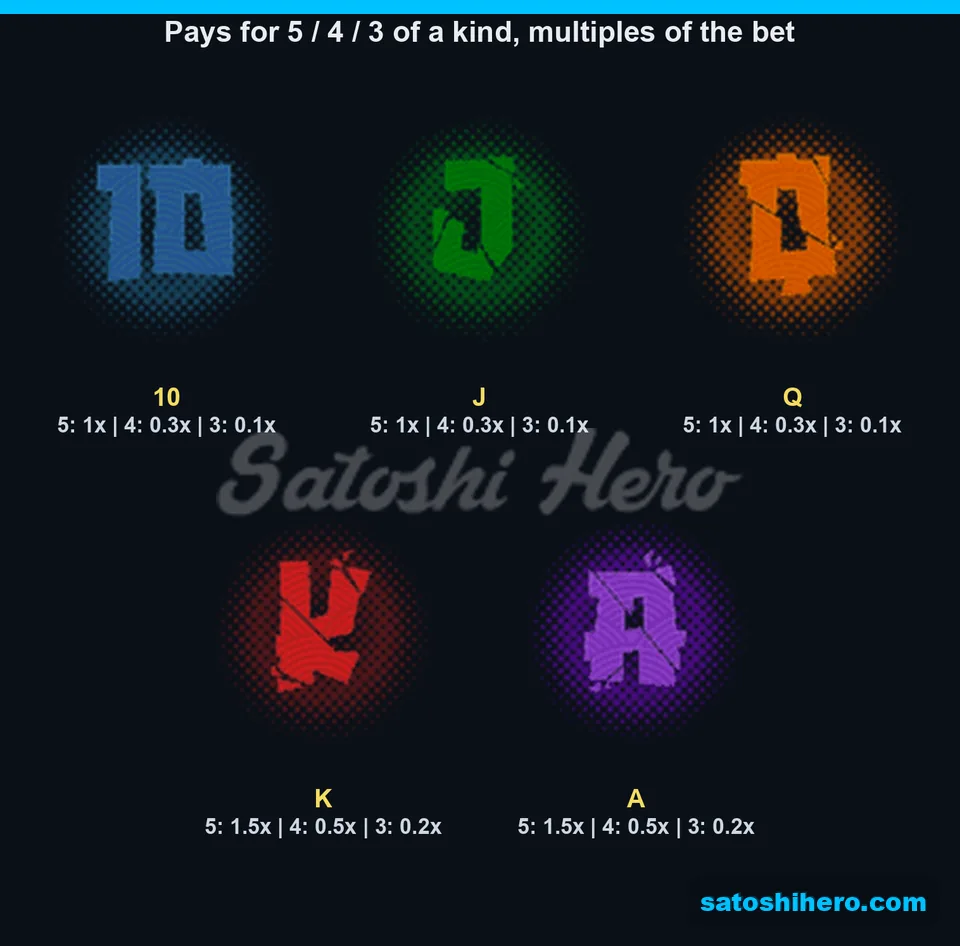
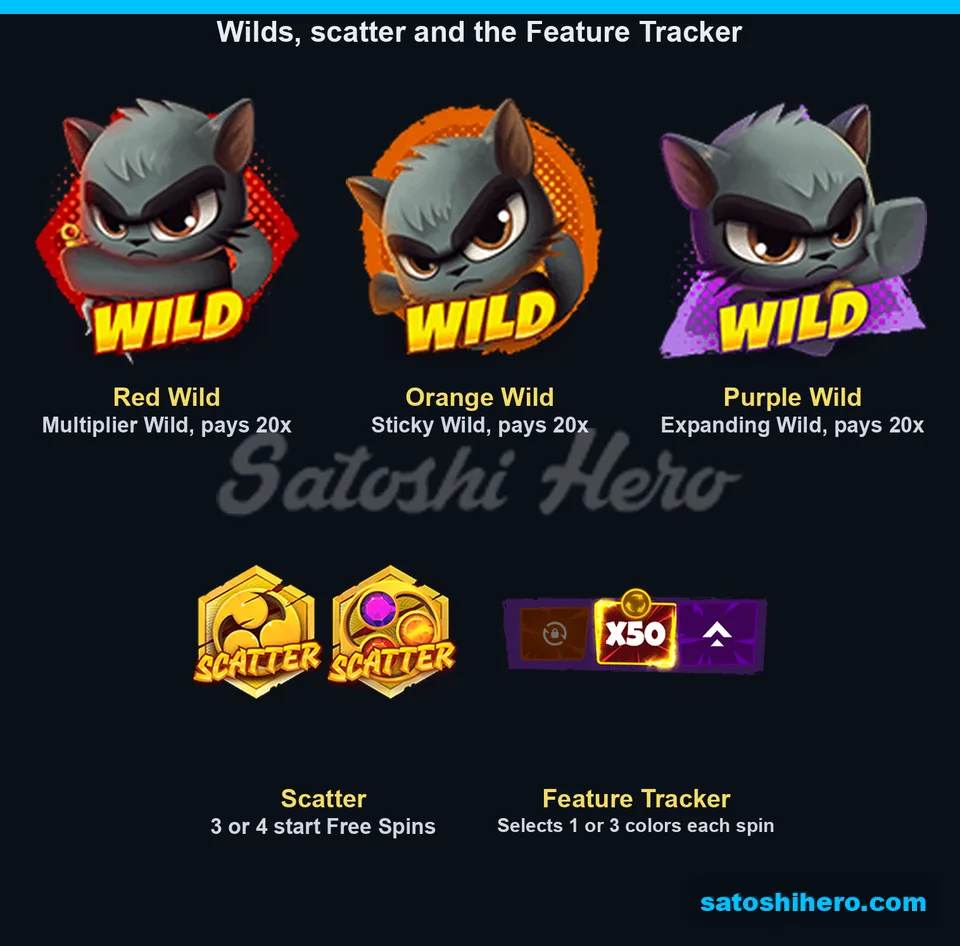
Card ranks 10, J, and Q pay 1x, 0.3x, or 0.1x. K and A pay 1.5x, 0.5x, or 0.2x. Each colored Wild cat substitutes for regular symbols and pays 20x for five when no feature activates. The hexagonal Scatter starts the eight-spin free-spin feature.
Before every spin, the Feature Tracker selects one color or all three. A matching Wild activates that feature, but several selected colors still produce only one respin. An active color adds nothing, and free spins disable respins. The tracker adds tension, though you may need several rounds before its logic feels natural.

Smart Move: Several selected colors don’t promise several respins. Check the tracker first, because a color matters only when its matching Wild lands.
Watch the tracker before each spin, rather than waiting for a Wild to appear.
Red Wild, Multiplier Wilds
A selected Red Wild starts a respin and adds one random value to the Global Multiplier. Possible additions are x2, x3, x4, x5, x10, x15, x25, x50, and x100. Those values accumulate instead of creating separate multipliers. You should read the displayed total before judging the line win beneath it.
The multiplier affects wins from the triggering spin and every later respin. Red Wilds disappear before the next result because they aren’t sticky, while each fresh Red Wild raises the total and grants another respin. From a design perspective, that link gives repeated Red arrivals the strongest apparent upside among the three colors. You still need the right line connections, so a large tracker value alone doesn’t create a payout.
I saw the practical sequence on spin 37. A x4 Global Multiplier turned a 1.2x line result into $4.80 at my $2.00 stake. That result confirmed the total affected the completed win. No large Red chain followed, and I won’t dress that modest example up as something bigger. You can see the feature’s promise there, but my result remained only 2.4x the stake after multiplication.
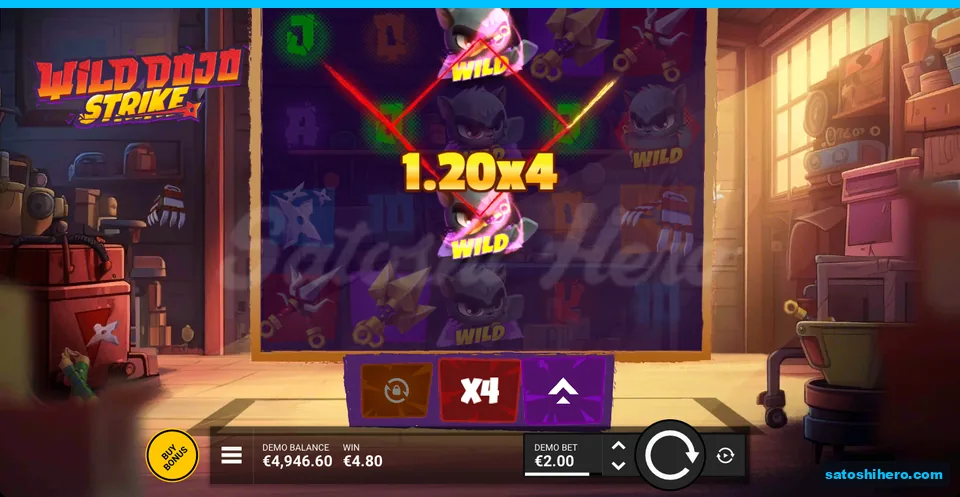
The engineering here rewards repeated matching Wilds rather than one lucky activation. That structure creates a clear cause-and-effect loop: another Red symbol increases both time and multiplier strength. I find it the most exciting color mechanically, though the test gave it little room to build. Real momentum needs repeated Red Wilds during the same sequence, not merely frequent tracker selections.
Theme and First Impressions
The slot uses a bright ninja-cat workshop theme that makes its color system easy to recognize. A cluttered dojo frames shuriken, nunchaku, claws, kunai, and brush-painted card ranks. Red, orange, and purple cats command your attention, while a hexagonal Scatter anchors the bonus imagery. You can identify each feature faster through color than through text.
Each cat acts as a visual label tied to one effect. Red signals multipliers, orange marks sticky positions, and purple indicates full-reel expansion. The tracker stays below the reels, letting you check eligible colors before each result. I think that placement works well because your eyes move naturally from the selector into the grid.
The ninja-cat setting won’t win originality awards, but its characters make the denser rules easier to retain. Premium weapon tiles look distinct enough during rapid play, and low card ranks remain readable. My $2.00 stake and balance also stayed visible without competing against the artwork. That’s useful when you need to follow both spending and feature eligibility.
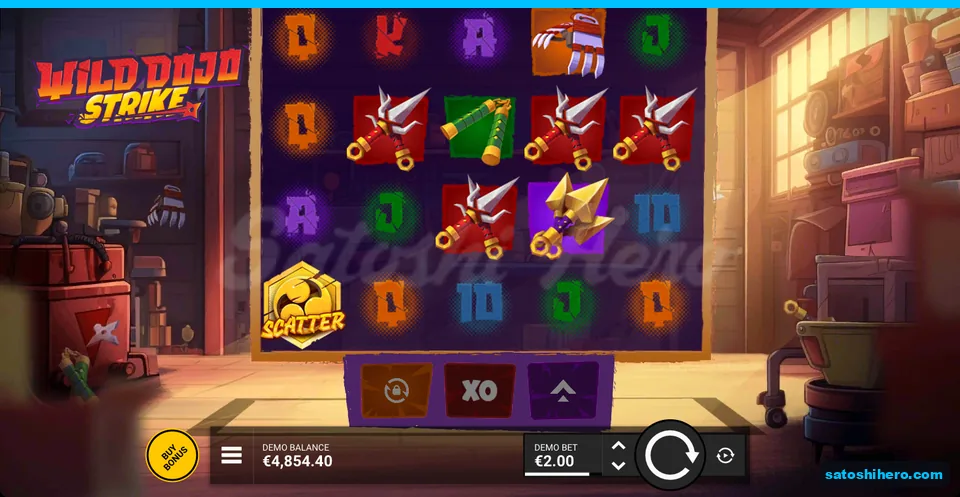

Lore: The three ninja-cat colors double as visual labels for sticky, multiplier, and expanding effects. Their designs teach the interface before you remember every rule.
Bullshark keeps the presentation lively without burying the mechanical information. I would’ve preferred a less familiar ninja backdrop, yet the color coding carries more practical value than a novel setting would. Once you’ve learned the cats, you can follow a busy respin sequence at a glance. The art serves the mechanics well, even if the wider theme feels familiar. Other color-led Wild options include Wild Witches, Wild Wild Steel, Wild Wild Gold, and Wild Wild Fruit.
Wild Dojo Spins
Landing three or more Scatters awards eight free spins, with the trigger count deciding which features start active. With three, all colors begin inactive, so you must match a selected tracker color with its Wild. I never reached this bonus during my test, making these rules documented rather than observed. Four Scatters start every colored effect active immediately.
Each Scatter inside the feature adds one spin. Respins don’t occur there, which changes how every colored Wild behaves. Orange Wilds remain sticky until the bonus ends, Purple Wilds expand without staying sticky, and Red Wilds add random values to one Global Multiplier. That multiplier affects every bonus win, so you should track its growth across the whole round.
A natural three-Scatter trigger asks you to unlock the system piece by piece. Its four-Scatter counterpart starts at full mechanical strength. I like how extra trigger symbols change the feature state, not just the spin count.
Direct entry to Wild Dojo Spins costs $200.00 at the tested $2.00 stake. Extreme Wild Dojo Spins costs $400.00 and begins with every color active. I bought neither entry, so I can’t call Extreme the better purchase. You should view each price as a cost, not evidence of likely returns.
Bonushunt FeatureSpins cost $6.00 and make a free-spin trigger five times more likely. FeatureSpins cost $40.00 and ensure a matching Wild for respins. Both cheaper menu choices also remained untested in my session. Only firsthand purchase results could support a value judgment.
Orange Wild, Sticky Wilds
A selected Orange Wild locks into place and starts a sticky-Wild respin sequence. Every new Orange Wild also sticks and adds another respin. My test produced no standout Orange sequence, despite regular respin activity. You should watch fresh arrivals because existing sticky symbols don’t extend the chain.
In the base game, Orange Wilds remain fixed until that chain finishes. During free spins, they stay locked until the whole bonus ends. I like how one visual rule gains extra power without changing the symbol’s identity.
Orange is the easiest colored mechanic to follow because every held position remains visible. Its value still depends on another Orange Wild landing before the base-game sequence stops. A sticky cat can help connect several later lines, but it doesn’t raise a multiplier or cover its entire reel. You get positional stability rather than explosive scaling.
Sticky symbols can look more powerful than their final payouts. You still need useful symbols around each locked position. I found the feature clear to watch, though its practical impact felt limited in this weak run.
Red builds multiplication, Purple widens line coverage, and Orange preserves one exact location. If you prefer visible progress, Orange gives the clearest feedback. Its strength comes from fresh arrivals, not one cat sitting through an empty sequence.
How the 100 Spins Played
My 100-spin session lost $145.60, and most paying spins returned less than the $2.00 stake. Every counted spin ran in Super Turbo from a fresh $5,000.00 balance. I excluded two brief control-check sessions from every reported result. You can treat the log as 100 regular spins without a bonus purchase.
I wagered $200.00 and received $54.40, finishing at $4,854.40. Thirty-two spins paid, yet 22 stayed below stake and only 10 matched or beat it. My balance never crossed its starting point, and the finish marked the session low.
The largest result was $9.60 on spin 62, equal to 4.8x after one respin. Spins 28 and 82 each returned $7.00, while spin 37 produced $4.80 under the x4 Red multiplier. My longest losing stretch covered spins 13 through 21, nine results without a payout. I found that combination harsh, though one short test can’t define the game.
Thirteen starting spins activated at least one respin and created 16 altogether. Spins 35, 36, and 40 each generated two. No free-spin round appeared during the 100 counted spins. Frequent feature movement didn’t translate into meaningful returns for my bankroll.

Red Flag: This session is a bankroll example, not a prediction. One hundred $2.00 spins required $200.00, while one Extreme entry cost twice that entire test stake.
You can trigger many respins and still lose when most wins remain small. I liked the color logic, but weak payouts barely rewarded that complexity. Respin frequency isn’t a reliable sign of strong returns.
Purple Wild, Expanding Wilds
A selected Purple Wild covers its full reel for the triggering spin and one respin. Any fresh Purple Wild there expands and grants another respin. My test produced no standout Purple-led win during the counted session. You should inspect its reel because left-side expansion often carries more connection potential.
Full-reel Purple creates width, while Orange preserves one exact position. It doesn’t remain sticky, whereas Orange stays locked until base-game respins finish. I like how you can understand each purpose without reopening the rules.
Inside free spins, Purple Wilds still expand across their reels but never stay sticky. No extra respin follows because the bonus disables respins altogether. That version can broaden several line combinations on one result, yet it can’t prolong the round by itself. You get immediate reel coverage instead of persistent positions or extra time.
The effect looked dramatic, but its payouts stayed within the session’s modest range. That gap between visual scale and cash result matters. I find Purple easier to appreciate structurally than financially after this test.
Value depends heavily on reel location and surrounding symbols. A full Wild reel supports many lines, but dead left-side connections still limit it. You should read Purple as broader coverage, not an automatic large win. Orange offers persistence, while Purple trades that persistence for one-reel reach.
RTP, Volatility and Our Test
The theoretical return is 96.27%, volatility is medium, and the win cap reaches 12,000x the bet. That profile balances payout size and hit rhythm by design, but it doesn’t promise a smooth short session. A cap result pays immediately and ends the round. You should keep these official specifications separate from both modeled ranges and my observed result.
The Simulator Projection
The median 1,000-spin simulation finished $94.40 down at $2.00 per spin. It used the stated return profile, volatility, and payout cap as inputs. The fifth-percentile result ended $405.30 down, while the ninety-fifth-percentile result finished $335.80 up. I find that $741.10 span more informative than the central result because it shows how widely sessions can separate.
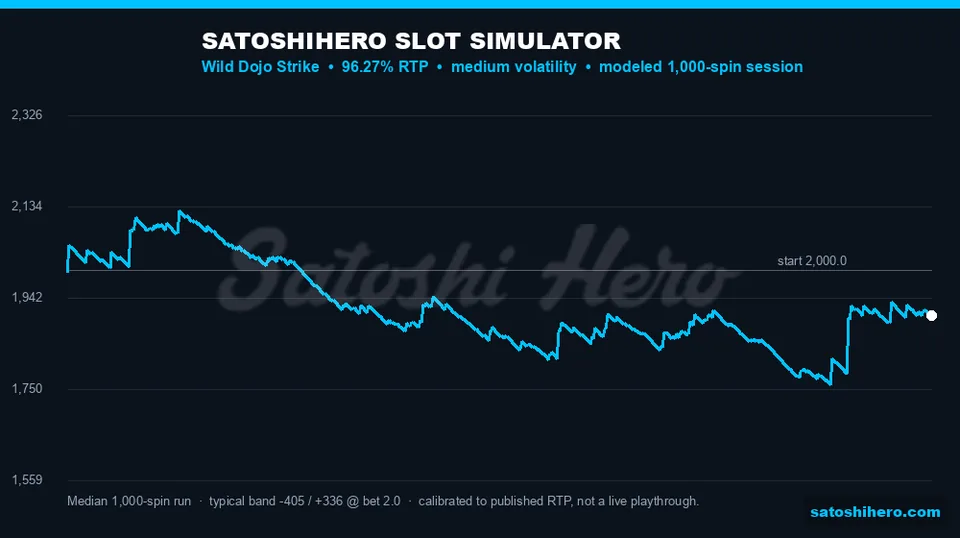
The model produced a win on 25% of spins. A result worth at least 100x appeared about once per 12,987 modeled spins, far beyond one 1,000-spin run. Our simulator doesn’t reproduce Bullshark’s random number generator or forecast your next session. You should read it as a distribution exercise, not a countdown to a large payout.
Percentiles frame the model more usefully than one average line. The fifth-percentile path represents a severe losing side, while the ninety-fifth shows that a profitable run still fits the same assumptions. Neither boundary acts as a floor or ceiling for real play. I prefer this range because you can see uncertainty instead of mistaking the median for an expected personal result.
Our 100-Spin Session
Thirty-two spins paid in my live test, yet I still lost $145.60. Twenty-two payouts were smaller than the $2.00 stake, and my best result stopped at 4.8x. Respins appeared often enough to demonstrate the central loop, but Free Spins never arrived. In my view, this contrast explains why raw hit counts can mislead you.
The balance path supplied another useful session signal. It never rose above $5,000.00, and the last spin left it at the lowest point. There was no late recovery masking the earlier losses. You could feel the session eroding through many small returns rather than one dramatic collapse, which made the weak finish especially instructive.
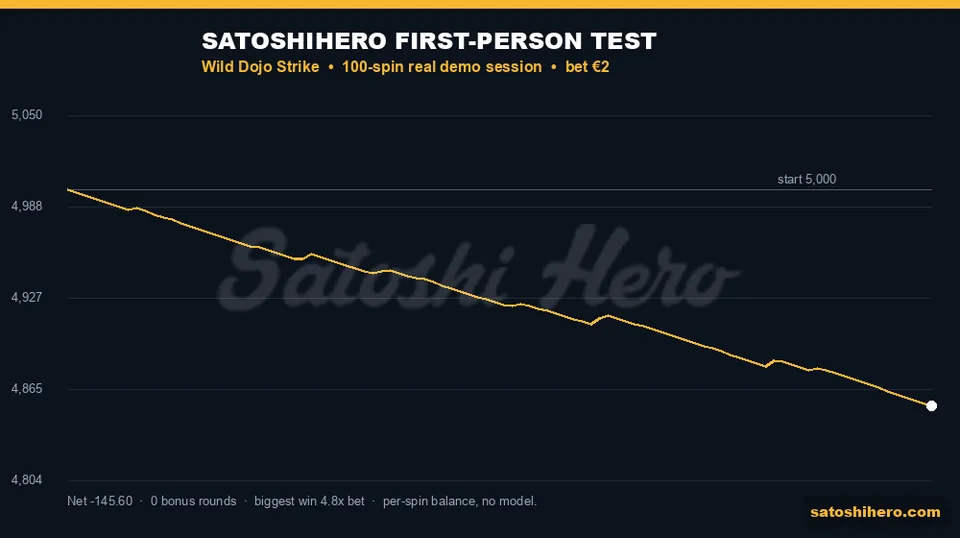

Key Number: Thirty-two paying spins didn’t mean 32 profitable spins. Twenty-two payouts returned less than the $2.00 stake.
The operator-published theoretical figure describes the game’s expected return profile, while one live session has no bearing on that figure. Simulator outputs represent modeled ranges rather than promises, and bonus-mode settings can differ slightly by design. I didn’t purchase a bonus, so this test can’t establish any bonus-specific return. The methodology matches the displayed game information, and the model shows uncertainty more honestly than one isolated result.
Frequently Asked Questions
How does the Feature Tracker work in Wild Dojo Strike?
It selects one color or all three before every spin. A matching Wild activates that color and grants a respin, but landed Wilds can award only one respin when several colors are selected. Re-selecting an active color adds no further feature effect. You should check the tracker before the reels stop, since eligibility controls the feature.
What does each colored Wild do in Wild Dojo Strike?
Orange stays sticky through its respin sequence, Red adds x2 through x100 to the Global Multiplier, and Purple expands across one reel. A fresh matching Wild extends the related base-game respins. I find Orange easiest to follow, while Red carries the clearest scaling potential. During free spins, the same colors follow modified bonus rules without respins.
How do Wild Dojo Spins start?
Landing three or more Scatters grants eight free spins. With three Scatters, every feature starts inactive, whereas four activate all three from the first spin. Each later Scatter adds one extra spin to the feature. You must unlock colors after a three-Scatter trigger, so that version starts with more setup work.
Which choices appear in the Wild Dojo Strike Bonus Buy menu?
At a $2.00 stake, Bonushunt FeatureSpins cost $6.00 and FeatureSpins cost $40.00. Wild Dojo Spins cost $200.00, while Extreme Wild Dojo Spins cost $400.00. I purchased none of these four menu choices. Extreme has the richest opening state, but its setup doesn’t prove better value.
What did the simulator show for Wild Dojo Strike?
The median 1,000-spin run lost $94.40 at $2.00 per spin. Its range stretched from a $405.30 loss at the fifth percentile to a $335.80 gain at the ninety-fifth. The modeled win rate reached 25% across those simulated spins. You can’t use those outputs to predict one personal session.
How did my 100 live spins go?
I started with $5,000.00 and finished with $4,854.40, losing $145.60 across regular $2.00 spins. Thirty-two spins paid, my largest result reached 4.8x, and 13 starting spins activated respins. No Free Spins appeared, and I bought no bonus. I consider it an unusually weak short run, not a forecast.
What are the Wild Dojo Strike RTP and maximum win?
Wild Dojo Strike has 96.27% RTP, medium volatility, and a 12,000x maximum win. Reaching that ceiling ends the round immediately and pays the capped result. Those specifications can’t guarantee any individual session outcome. My short test finished far below its total stake despite 32 paying spins.
The Takeaway
Wild Dojo Strike layers three readable Wild systems over familiar fixed paylines. Its tracker creates tension, but my session turned frequent respins into little cash.

My Call
Traditional line-slot fans drawn to active states should try regular spins before considering costly entries. Expect clear logic and the possibility of a flat session dominated by small payouts.
I like how each color changes a different part of the win process. Yet I don’t like that 16 respins returned only $54.40 from $200.00 wagered. Visible feature activity can coexist with a steep loss.
Wild Dojo Strike rewards attention because you need to read the tracker before every result. The rules and test method are updated periodically.

Pros:
 Readable color system: Each cat signals one distinct mechanic before the reels settle.
- Layered respins: Fresh Wilds can extend sequences and improve line-building potential.
- Meaningful Scatter tiers: Four Scatters start every colored feature active immediately.
- Transparent line play: Fixed paylines make ordinary wins simple to verify.

Cons:
 Weak tested return: My $200.00 stake produced only $54.40 back.
- Costly direct entries: The two bonus entries cost 100x and 200x stake.
- Complex tracker rule: Several selected colors still grant only one respin.

Best For: Fixed-line fans who enjoy state tracking, sticky positions, expanding reels, and additive multipliers. You should accept that medium volatility can still produce a harsh short run, especially when most paying spins return less than stake.


































































Bets
All Bets
Game
Player
Date
Wager
Mult.Multiplier
Prize
 Wild Buffalo Megaways: Hold N Link
 nina87
- 04:22:06
- 0×
- Pelican's Bay: Rapid Link
 Hidden
- 04:22:05
- 0.89×
- All Lucky Clovers 100
 riannewessels1988
- 04:22:04
- 0×
- Wild Buffalo Megaways: Hold N Link
- nina87
- 04:22:03
- 0×
- All Lucky Clovers 100
- riannewessels1988
- 04:22:01
- 0×
- Wild Buffalo Megaways: Hold N Link
- nina87
- 04:22:00
- 0×
- All Lucky Clovers 100
- riannewessels1988
- 04:21:59
- 0×
- Galaxy Glitter
- mike_721
- 04:21:58
- 0×
- All Lucky Clovers 100
- riannewessels1988
- 04:21:57
- 0×
- All Lucky Clovers 100
- riannewessels1988
- 04:21:57
- 21.99×