

Deep Descent
By pressing play, you agree that you are above legal age in your jurisdiction and that your jurisdiction allows online gambling.

Deep Descent
RTP95%
VolatilityHigh
Max winx18,814
Ways3,125
Hit rate25.66%
ThemeUnderwater world
ReleasedAug 2021

Sinking Past the Safe Blue Surface
Deep Descent slot looks calm on the surface, but the way its Wild Respins keep dragging you deeper makes it a much sharper game than the cartoon diver theme first suggests.
Deep Descent is a High volatility underwater slot from Relax Gaming, playable on SatoshiHero in demo and real-money mode. It has a 95.00% RTP, an 18,814x max win, and a 243-ways setup that can expand to 1,024 ways and 3,125 ways. Active-feature fans get the most from it, while free-spins hunters and bonus-buy chasers may bounce off quickly.
Key takeaways
There’s no bonus buy, no ante bet and no free spins. Wild Respins, the collection meter and depth progression carry the whole game, and that matters because the 95.00% RTP sits lower than I’d like for a High-volatility Relax Gaming slot.
- Best play: There’s no bonus buy, so you chase Wild Respins, meter progress and deeper rows.
- RTP / volatility: Deep Descent has a 95.00% RTP and High volatility, so expect dry patches between meaningful hits.
- Max win: The official top win is 18,814x bet, which gives the math real ceiling.
- Risk note: Most tested respins stayed on level 1 and paid around $20 to $35 at a $2.00 stake.
- Bankroll note: My 500-spin test ended $45.00 down, while the simulator median was $156.90 down at the same stake.

Key Stat: Deep Descent slot has no free spins, bonus buy or ante bet. Wild Respins are the main event, so every meaningful session leans on the base-game feature engine.

Table of Contents
- How Deep Descent slot Works
- Ways, not lines
- Wild tile basics
- Symbol Values and Paytable Notes
- Top symbol payouts
- Lower symbol hits
- Theme & First Impressions
- Underwater setup
- Visual clarity
- Wild Respin Feature
- Locked Wild counts
- How it played
- Collection Meter
- Chosen suit
- Meter carryover
- Depth Level Progression
- Opening new rows
- Direct level jumps
- RTP, Volatility & Our Test
- Simulator projection
- Our 500-spin session
- How the Session Actually Felt
- Frequent small features
- Late-session recovery
- Frequently Asked Questions About Deep Descent
- Final Verdict
How Deep Descent slot Works
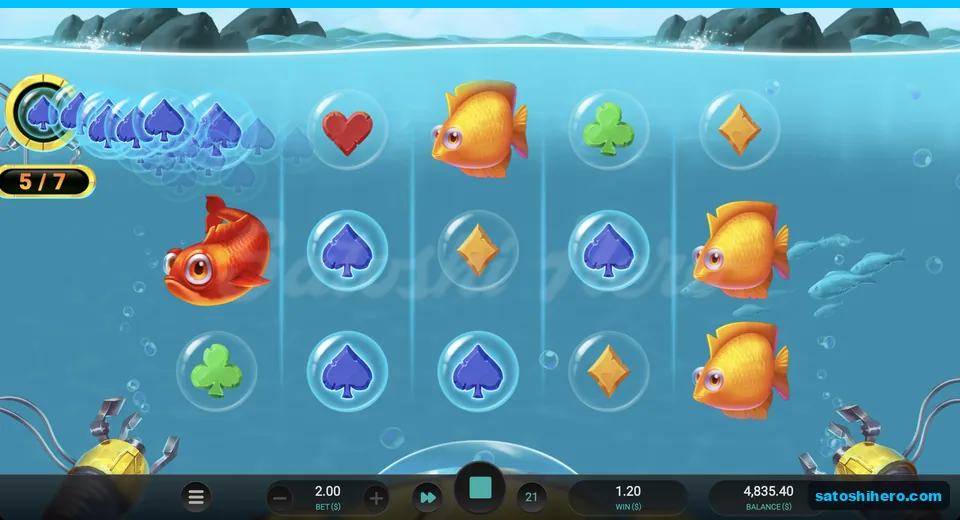
Deep Descent slot works as a ways-pay game, not a fixed-payline slot. You win from left to right when matching symbols land on adjacent reels in any position, and extra copies on a reel multiply the result.
The starting layout uses 5 reels and 3 rows, creating 243 ways to win. You don’t need symbols on neat lines, so the screen feels more flexible than an old fixed-line setup. Still, small ways wins can look busier than they feel, and you’ll notice that fast at a $2.00 stake.
Ways, not lines
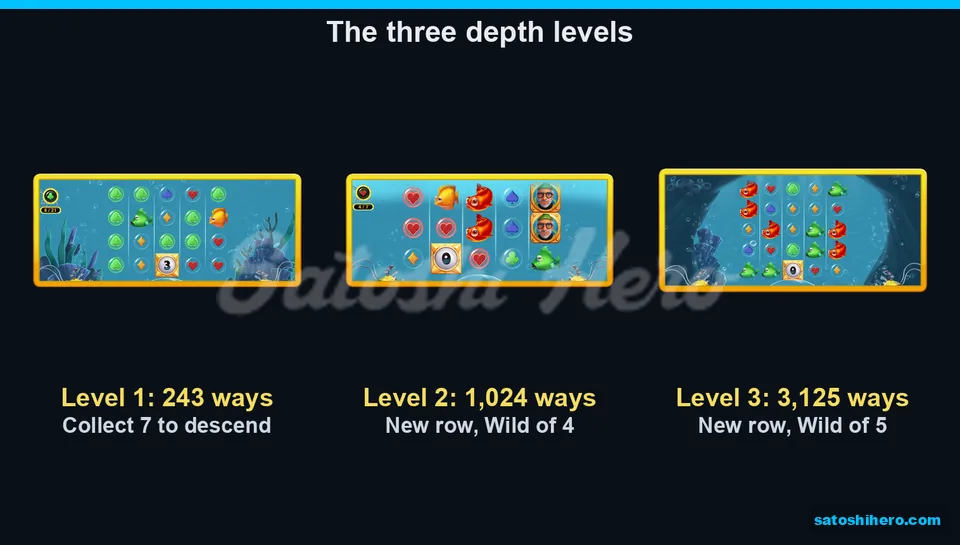
Numbers indicate the first real jump comes from depth progression. Level 1 gives you 243 ways, level 2 opens a fourth row for 1,024 ways, and level 3 opens a fifth row for 3,125 ways. The layout remains readable on both desktop and mobile because the expanding rows open beneath the reels without cluttering the symbols.
That readability matters more than it sounds. When the feature starts counting Wilds down, you need to track the board quickly. Wild Yield also leans into active base-game play without a classic free-spins chase, but this game feels more focused on board expansion.
Wild tile basics
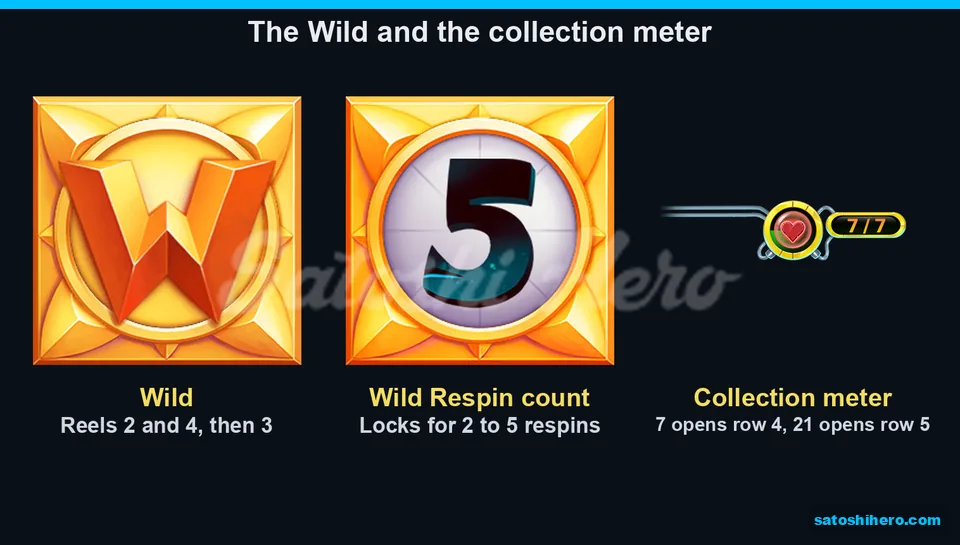
The gold W Wild substitutes for paying symbols and lands on reels 2 and 4. Once every row opens, it can also land on reel 3, which gives the deeper board more bite. You should watch the Wild position as closely as the symbol value, because one locked tile can extend a round.
The base setup feels plain until the meter starts pushing the grid lower. Deep Descent slot only becomes properly exciting when those extra rows open and the ways count starts working harder for you.
Symbol Values and Paytable Notes
The Old Diver is the key paying symbol because it pays for two, while fish and bubble suits often need stronger ways volume to matter. At a $2.00 stake, that difference shaped most of my lower-level hits.
Top symbol payouts
The Old Diver portrait pays $20.00 for five, $8.00 for four, $4.00 for three and $2.00 for two. That two-symbol payout helps the game avoid total dead air when the reels line up early. You can feel why Relax Gaming made him the face of the paytable.

Red Fish pays $5.00 for five, Yellow Fish pays $4.00 and Green Fish pays $3.00. Those numbers don’t sound awful, but they rarely rescued weak spins during my test. The math suggests you need Wild help or expanded ways before fish hits feel meaningful.
Lower symbol hits
The four bubble suits are heart, diamond, club and spade. Each pays $1.60 for five, $0.60 for four and $0.20 for three at the same $2.00 stake. You’ll see them often, but you shouldn’t treat them as strong base wins on their own.
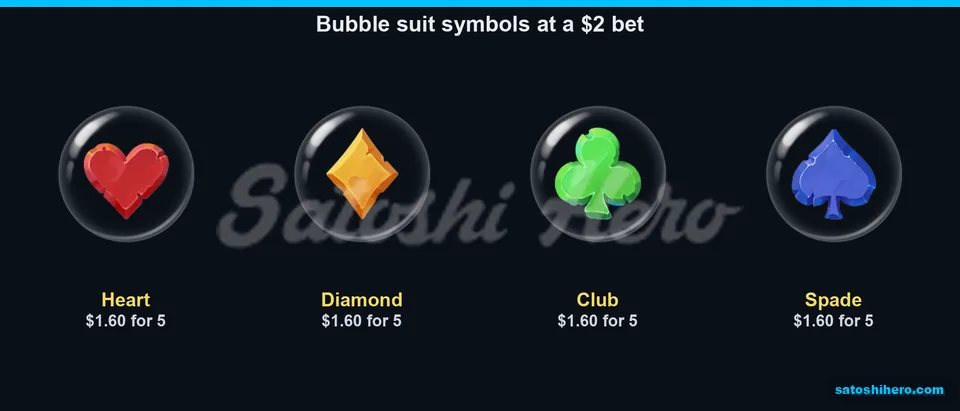
Small fish and bubble-suit hits often failed to cover the stake during testing. That made the respin feature feel essential, not decorative. Deep Descent slot has a modest low-symbol paytable, so the collection meter needs to turn cheap suit wins into real progress.
Theme & First Impressions
The theme is clean, readable and more useful than flashy, which helps when Wild Respins start stacking symbols and rows. Deep Descent keeps its underwater world simple, but that choice supports the mechanic.
Underwater setup
An old diver in a green beanie and round glasses sinks toward the seabed. Clear blue water fills the background, with a rocky shoreline above and yellow diving bells below. Bubbles drift past the symbols, giving the screen movement without turning it messy.
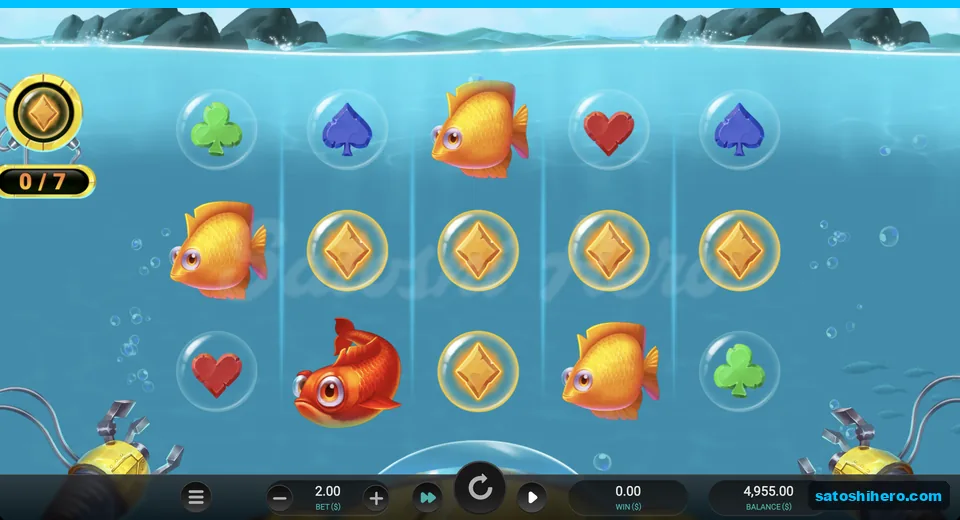
The slot starts compact at 5×3, then feels more dramatic when deeper rows open. You can tell the visual descent links directly to feature progress. Wild Hike has a brighter outdoor adventure mood, while this game stays cooler, quieter and more mechanical.

Insight: The visual descent matters because the game physically opens new rows as the feature deepens. That makes the theme part of the math display, not just decoration.
Visual clarity
The theme won’t win originality awards, but the execution is clean and readable. I’d rather have that here than a busier ocean scene that hides the Wild counts. You need clear symbols when countdowns and meter movement happen together.
Deep Descent slot uses its setting in a practical way. The deeper rows give the board a real sense of movement, and you can follow the action without squinting. The theme supports the mechanic instead of distracting from it.
Wild Respin Feature
The Wild Respin is the main feature, and it starts when a Wild lands, flips to a number from 2 to 5, then locks while the reels keep respinning. Deep Descent Wild Respin rounds replace the usual free-spins chase, so you need to enjoy this loop.
Locked Wild counts
A Wild locks in place after it reveals its number. The reels respin, the count drops by one after each respin, and the Wild remains until it reaches zero. Respins continue while any Wild stays on the board.
New Wilds can land during the sequence and bring their own countdowns. That creates the best tension in Deep Descent slot, because a weak start can still grow. You’re not just waiting for one payout, you’re watching whether the board can keep itself alive.


Strategy Insight: Watch the Wild count, not just the first hit. A low-paying respin can improve quickly if another numbered Wild lands before the first one expires.
How it played
Wild Respins fired often in my 500-spin session. I counted around 18 respin rounds, which made the game feel more active than the balance graph looked. Most stayed at level 1 and paid around $20 to $35 at a $2.00 stake.
That frequency gave the session rhythm, even when the money didn’t move much. You get plenty to watch, but many rounds end before the fourth row arrives. The feature can feel active even when it doesn’t produce a major hit.
Collection Meter
The collection meter chooses one bubble suit each paid round, then counts winning copies of that suit toward deeper reel levels. Deep Descent collection meter progress gives small suit wins a reason to matter.
Chosen suit
At the start of every round, one of the four bubble suits gets picked at random. The selected suit appears in the meter at the top left, so you can see the target before the win lands. Every copy of that suit in a winning combination adds to the meter.
Wilds can help form the win, but they don’t count as collected suits. That rule matters because a Wild-heavy win may pay without pushing you deeper. I like the clarity, though it can sting when a good-looking board barely moves the meter.
Meter carryover
The meter carries through all respins in that paid round. It resets when the next paid round begins, so you need the progress to matter within that sequence. You can’t build a long-term meter across unrelated spins.
Insight: Wilds can help create the win, but they don’t add to the collection meter themselves. The chosen suit must appear in the paying combination, so watch the meter before judging a respin.
During my test, the meter made small bubble-suit wins feel more meaningful. Cheap hits that didn’t cover $2.00 still had a job if they pushed the round toward level 2. The meter turns small suit wins into feature progress.
Depth Level Progression
Depth progression opens more rows when the meter reaches key targets, turning 243 ways into 1,024 ways and then 3,125 ways. These jumps create the best moments in Deep Descent slot because the board finally starts breathing.
Opening new rows
Level 1 uses the 5×3 grid and 243 ways. At 7 collected symbols, level 2 opens a fourth row, raises the board to 1,024 ways, and places a Wild with a count of 4 on reel 3 in the new row. That locked Wild gives the upgrade immediate value.
At 21 collected symbols, level 3 opens a fifth row for 3,125 ways and adds a fresh Wild of 5. Numbers indicate a huge ways jump, but the route there isn’t easy. Wildchemy fans may recognise the appeal of layered build-up mechanics, though this one feels tighter and more urgent.
Direct level jumps
A single base-game win with 7 or more collectable suits can start respins directly at level 2 without a Wild. That rule helps the meter feel less passive, because one suit-heavy hit can kick the feature into a better state. You still need the right symbol spread.
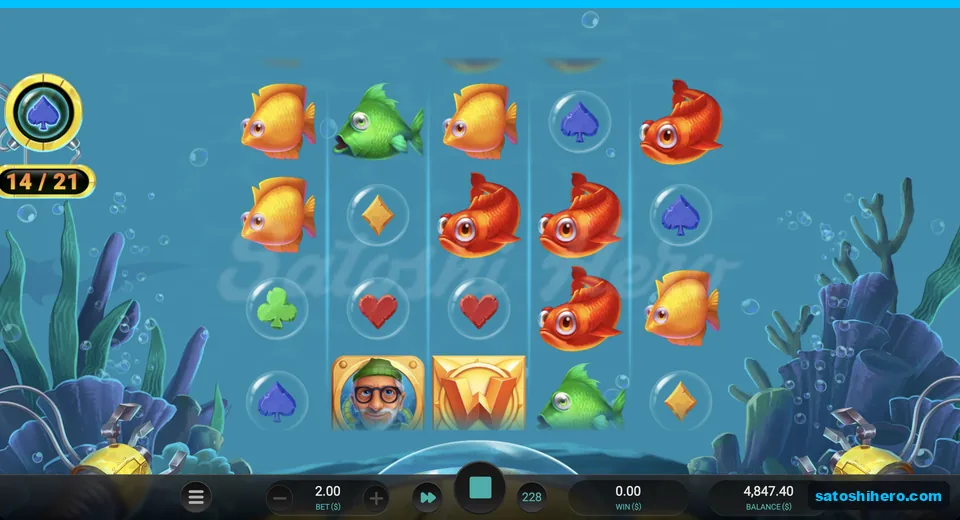
Respins end when a spin finishes with no Wild on the board and no new row unlocked. In my test, only two respin rounds reached a deeper level. The strongest visible level 2 example had the meter at 14 of 21 and two locked Wilds, which made the slot feel alive for a short burst.
RTP, Volatility & Our Test
Deep Descent has a 95.00% RTP, High volatility and an 18,814x bet max win, so the game can pressure your balance even when features appear regularly. The 95.00% RTP sits lower than many Relax Gaming players may expect.
High volatility shows up through uneven returns. Features can appear often, yet they don’t always repair the balance. That’s exactly what I saw when level 1 respins paid enough to entertain me, but not enough to erase the base-game leakage.

Warning: High volatility plus a 95.00% RTP means you should expect balance pressure between the better Wild Respin chains. Set a stake where 500 spins won’t feel like chasing.
Simulator projection
The SatoshiHero Slot Simulator ran 1,000 spins at a $2.00 stake using 95.00% RTP, High volatility and the 18,814x cap. The median session ended $156.90 down. The middle 90% of runs landed between $655.90 down and $695.30 up.
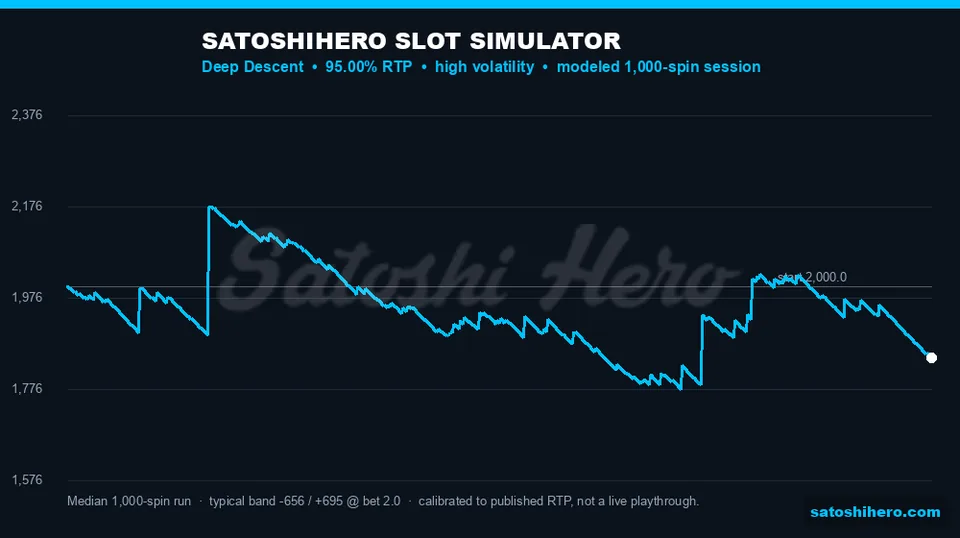
Roughly one spin in five paid. A feature-sized win appeared about once in 46 spins, while a 100x hit appeared about once in 1,786 spins. The band shows a spread of outcomes, not a prediction, and you shouldn’t treat it as a promise.
The lower return appears in that slightly deeper median loss. Still, the upper band shows why High volatility keeps the chase alive. Deep Descent slot can produce decent swings, but the average session may feel tight without a bigger respin chain.
Our 500-spin session
I played 500 spins at $2.00 with quick spin on. I started at $5,000 and finished at $4,955.00, leaving me $45.00 down. That result beat the model median, though the path still felt rough.
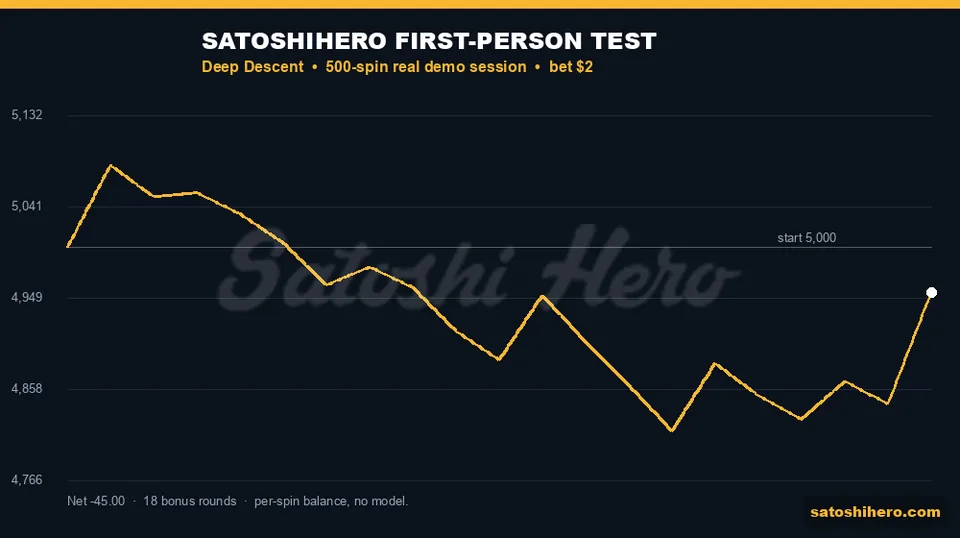
Wild Respins fired constantly, and I counted around 18 rounds. Spin 4 paid about $94 and lifted the balance to $5,098, which gave the session a friendly opening. Most later respins stayed on level 1 and paid between $20 and $35.
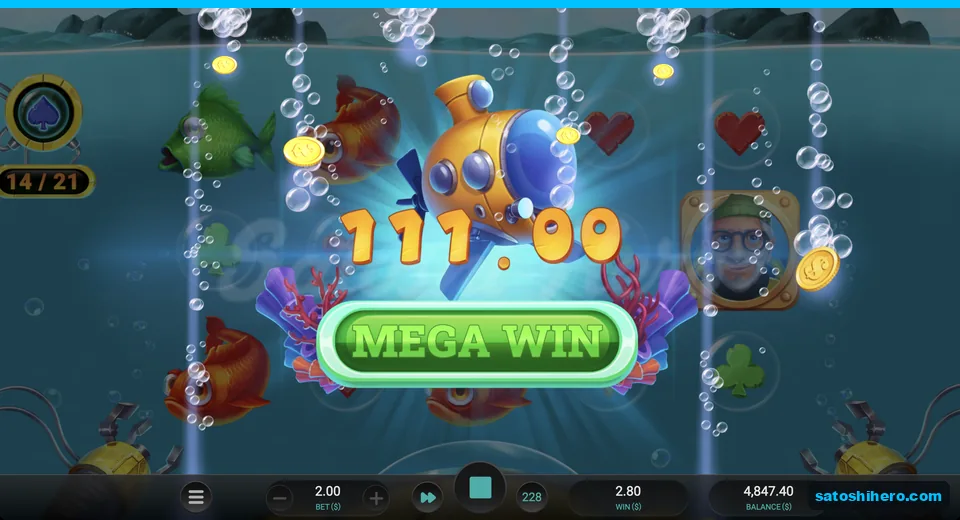
Spin 272 reached level 2 with the meter at 14 of 21, four rows and two locked Wilds. That round paid a $111.00 Mega Win. Around spin 355, another long chain paid about $102, but the balance kept sliding between features.
Spin 482 produced my best hit at about $157. It pulled the balance from $4,830 to $4,981, which changed the whole emotional read of the session. Between respins, small fish and bubble wins leaked money steadily.
The theoretical RTP is the operator-published figure, and one 500-spin session doesn’t prove or disprove that return. Simulator output plus live-session results give practical context rather than guarantees. Different feature states can sit slightly differently by design, while the headline game RTP remains 95.00%.
The test made the risk feel real, even though the final loss stayed modest.
How the Session Actually Felt
The session felt active because Wild Respins appeared often, but the base game kept draining balance between stronger chains. Deep Descent slot gave me plenty to watch, yet the balance line rarely felt safe.
Frequent small features
Wild Respins triggered regularly enough that I never felt stuck in a dead base game for too long. That’s a real strength. You get moving Wild counts, meter checks and occasional row pressure instead of waiting for a separate bonus round.
Most level 1 respins felt entertaining but not huge. The $20 to $35 results helped slow the damage, though they didn’t create much profit at $2.00 per spin. You can enjoy the movement while still feeling the math press back.
Late-session recovery
The late $157 hit changed my read of the test. Before that spin, the balance had slipped toward a heavier loss, and the base game looked too leaky. One stronger chain pulled the result back into modest-loss territory.
The max win is large enough to justify the High-volatility label, but normal play felt more like a repeated-respin grind than a constant big-win chase. Smaller stakes make sense if you want to give the respin engine time to develop. Patient feature watchers get the clearest value here.
Frequently Asked Questions About Deep Descent
How does the Wild Respin work in Deep Descent slot?
A Wild shows a number from 2 to 5 when it lands. It locks in place, the reels respin, the number counts down each respin, and respins continue while any Wild remains on the board.
What is the collection meter in Deep Descent slot?
Each round picks one bubble suit as collectable. Every copy in a winning combination adds to the meter, and the meter carries through the respins of that round.
How do the depth levels work in Deep Descent slot?
Collecting 7 opens a fourth row for 1,024 ways and adds a Wild of 4 on reel 3. Collecting 21 opens a fifth row for 3,125 ways with a Wild of 5.
Can you buy a bonus in Deep Descent slot?
No. There is no bonus buy, no ante bet and no free spins. Wild Respins and depth levels are the feature.
What did the 1000 spin simulator show for Deep Descent?
At $2.00, the median 1,000-spin session ended $156.90 down, with 90% of runs between $655.90 down and $695.30 up.
How did your 500-spin test of Deep Descent go?
My session finished $45.00 down after around 18 respin rounds. The best hit paid about $157 on spin 482, and a level 2 respin paid $111.00.
What are the RTP and max win of Deep Descent?
Deep Descent has a 95.00% RTP and an official maximum win of 18,814x bet.
Does Deep Descent slot have paylines?
No fixed paylines should be presented. The game pays through ways from left to right, starting at 243 ways and expanding to 1,024 ways and 3,125 ways as rows open.
Final Verdict
Deep Descent stands out because its Wild Respins give the base game constant motion. Its main drawback is the 95.00% RTP, which makes the High-volatility math feel sharper than the cute underwater theme suggests.

My Take
I’d play this when I want an active base-game feature rather than a classic free-spins hunt. You should expect plenty of respin rounds, but many of them may only soften the balance drop. The best sessions need meter progress, not just frequent Wilds.
I like how the meter makes small suit wins matter, especially when a level 2 jump adds a locked Wild. I don’t like how many base-game hits fail to cover a $2.00 stake. My 500-spin session stayed interesting, but the recovery depended heavily on the late $157 chain.
Deep Descent slot deserves a test run if you enjoy numbered Wilds, expanding rows and measurable feature progress. This guide is checked regularly, and the real-play angle matters because the game feels different on paper than it does across 500 spins.

Pros:
 Active Respins: Frequent Wild rounds keep the base game from feeling empty.
- Clear Progression: Meter targets make every collectable suit easy to track.
- Readable Layout: Expanding rows stay clean, so you can follow the feature.
- Real Ceiling: The 18,814x bet cap gives High volatility meaningful upside.

Cons:
 Lower RTP: The 95.00% return adds pressure during longer sessions.
- No Free Spins: Bonus-round fans may find the structure too narrow.
- Small Base Hits: Fish and suit wins often fail to cover $2.00.

Best For: Patient bankroll managers and feature trackers get the most from this slot. You’ll enjoy it more if you like watching Wild countdowns, meter progress and row expansion over classic free-spin rounds. Keep the stake modest if you want enough spins for the respin engine to show its range.












Other Relax Gaming Games




















































Bets
All Bets
Game
Player
Date
Wager
Mult.Multiplier
Prize
 Luck of Panda: Bonus Combo
 mike_721
- 09:09:15
- 0×
- Luck of Panda: Bonus Combo
 Hidden
- 09:09:15
- 0×
- Luck of Panda: Bonus Combo
- mike_721
- 09:09:12
- 0×
- Luck of Panda: Bonus Combo
- Hidden
- 09:09:12
- 0×
- Mardi Gras Queen
- josh1998
- 09:09:11
- 0×
- Piggy Bankroll: The Big Stash
 davidm5
- 09:09:10
- 0×
- 4 Royal Bags
- Hidden
- 09:09:10
- 2×
- Luck of Panda: Bonus Combo
- mike_721
- 09:09:09
- 0.75×
- 4 Royal Bags
- Hidden
- 09:09:08
- 0×
- Piggy Bankroll: The Big Stash
- davidm5
- 09:09:08
- 0×