

Phoenix Queen: Hold 'N' Link
By pressing play, you agree that you are above legal age in your jurisdiction and that your jurisdiction allows online gambling.

Phoenix Queen: Hold 'N' Link
RTP96.26%
VolatilityMedium
Max winx3,000
Lines30
Hit rate23.74%
ThemeAsia
ReleasedAug 2024
Live game stats
Real RTP95.19%
Spins22,007
Players26
Biggest win$164

When Locked Lotus Spheres Set the Reels Ablaze
Phoenix Queen: Hold ‘N’ Link combines 30 fixed paylines with locked-sphere respins and multiplier free spins.
This Netgame cherry-blossom fantasy slot uses a 5×3 grid and has a 96.26% RTP. I started with $1,000.00 at $4.00 and finished 98.25x ahead after three organic bonuses, though the base game contributed little. Traditional line-win fans who accept feature-driven swings can play the free demo or real game on SatoshiHero.
Key takeaways
- RTP and format: The theoretical RTP is 96.26%, with 30 fixed paylines across a 5×3 grid.
- Best bonus: Six Free Spin spheres start Hold ‘N’ Link, and every new sphere resets three respins.
- Test result: I finished 98.25x ahead, but ordinary wins returned only about 34.75x from 100x staked.
- Jackpot awards: Mini pays 10x, Minor 25x, Major 500x and Maxi 2000x at 12 through 15 spheres.
- Bankroll note: My balance reached $914.00 before the first feature, so you shouldn’t size your stake around the profitable finish.
The organic route provides the tested evidence. A Buy Bonus exists, but I didn’t use it, and separating those paths gives you a fairer picture.

Table of Contents
- How Phoenix Queen: Hold ‘N’ Link Works
- Line And Symbol Pays
- Wilds And Spheres
- Hold ‘N’ Link Respins
- Trigger And Resets
- Tested Bonus Result
- Multiplier Free Spins
- One Spin Per Sphere
- Individual Multipliers
- Four Jackpot Tiers
- Sphere Thresholds
- Mini In Testing
- Theme and First Impressions
- Blossom Fantasy Setting
- Clarity On Screen
- Buy Bonus Access
- Direct Feature Entry
- Testing Limit
- How the Base Game Played
- Ordinary Spin Results
- Bonus Dependence
- RTP, Simulator and Our Test
- Simulator Projection
- Our 100-Spin Session
- Frequently Asked Questions About Phoenix Queen: Hold ‘N’ Link
- Final Word
How Phoenix Queen: Hold ‘N’ Link Works
Phoenix Queen: Hold ‘N’ Link runs on a 5×3 grid with 30 fixed paylines. Matching symbols pay from left to right, and only the highest win on each individual line counts. You aren’t playing a ways, cluster or pay-anywhere system. I like that familiar structure, although the line game feels plain beside the feature.
Line And Symbol Pays
Every paytable amount represents a multiple of your total bet. At my $4.00 stake, five Queen Wilds showed $70.00, confirming the listed 17.5x value. You should read each figure as a line payment, not the full return from every winning line on that spin.
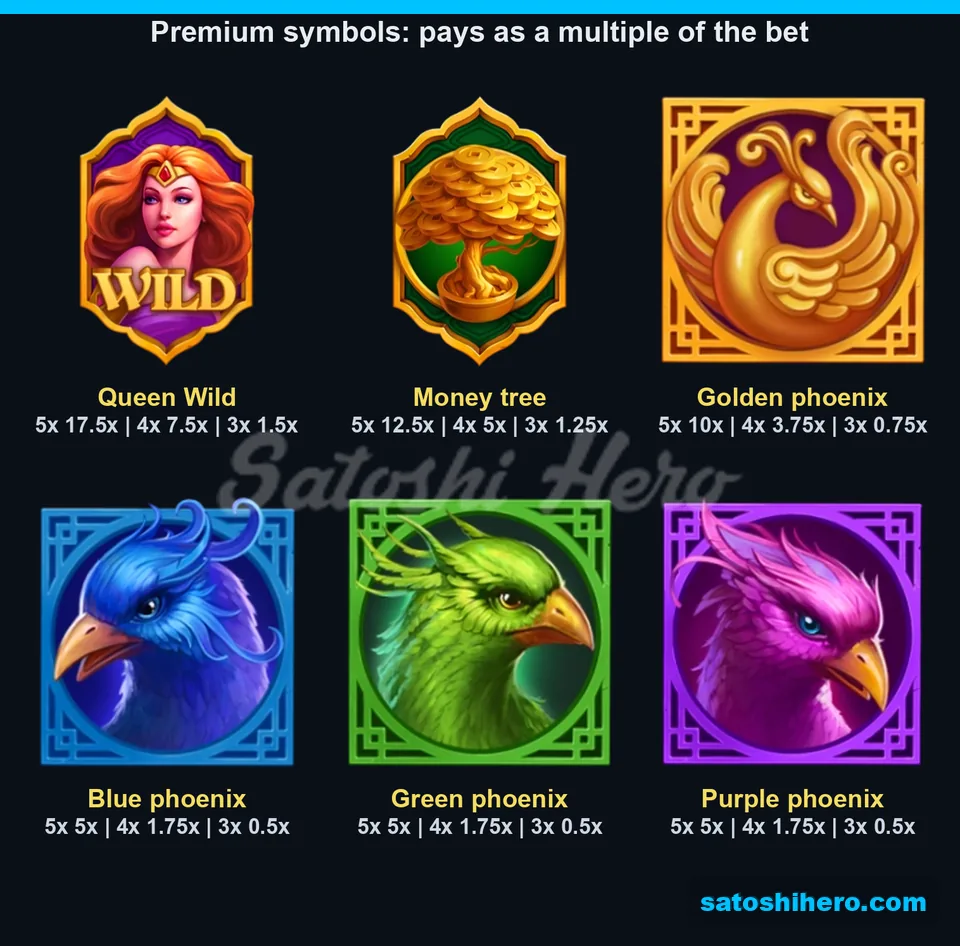
The stronger symbols pay these amounts for five, four or three matches:
- Queen Wild: 17.5x, 7.5x and 1.5x.
- Money tree: 12.5x, 5x and 1.25x.
- Golden phoenix: 10x, 3.75x and 0.75x.
- Blue, green and purple phoenixes: 5x, 1.75x and 0.5x.
- Ace, King, Queen, Jack and Ten: 2.5x, 1.25x and 0.25x.
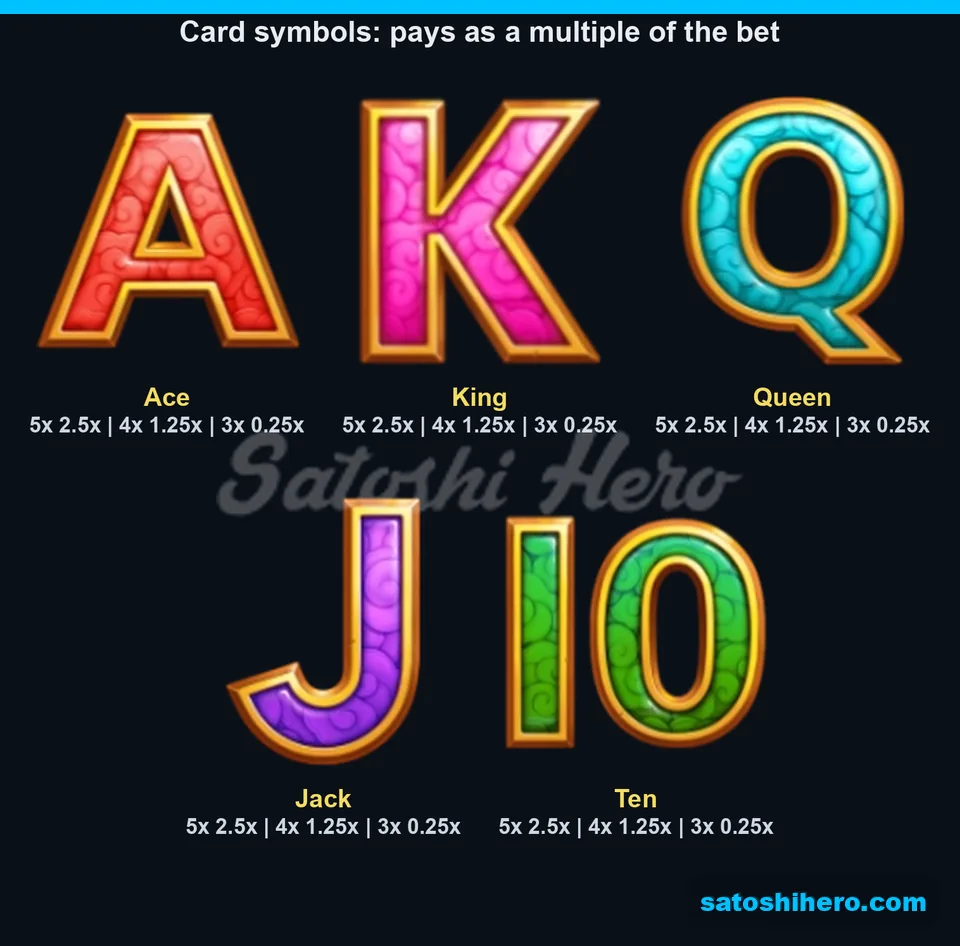
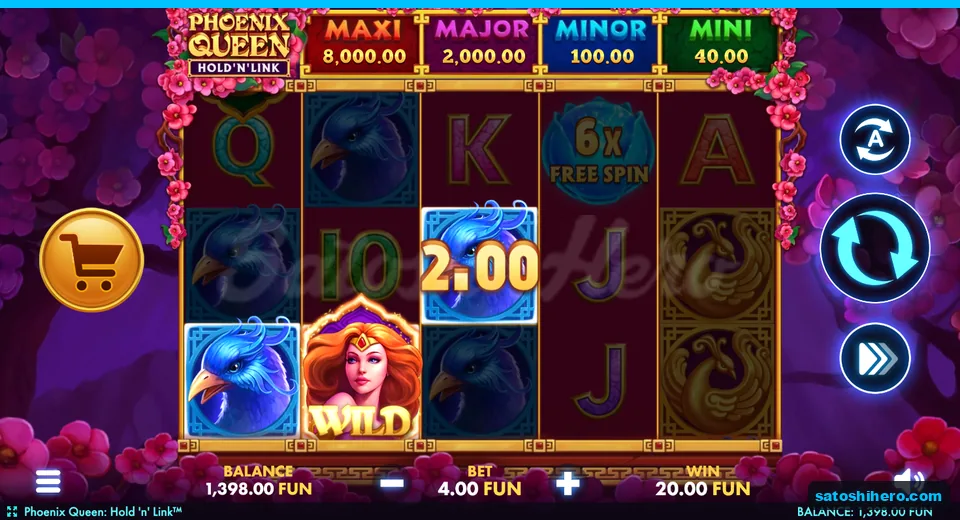
I saw a blue phoenix, Queen Wild and blue phoenix land across one line. Their 0.5x value produced a $2.00 line payment at my $4.00 stake. That check matters because you can distinguish one verified line win from the total shown after several paylines connect.
Wilds And Spheres
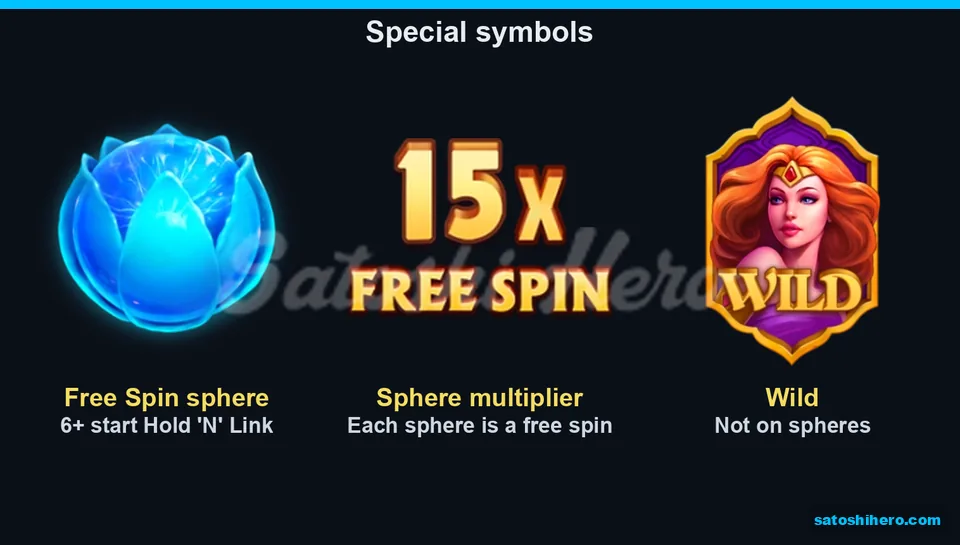
The Queen Wild replaces every regular paying symbol, but it can’t replace a Free Spin sphere. Blue lotus spheres carry no standard line-pay value. Six or more visible spheres start the bonus, so you should count them rather than treat them like ordinary symbols.
There isn’t a Phoenix Queen: Hold ‘N’ Link hack that controls sphere timing or placement. Your practical choice is learning the six-sphere trigger and setting a stake you can sustain. The Big Game Hold ‘n’ Link also uses the broad lock-and-respin idea, but its triggers, prizes and mathematics shouldn’t be assumed to match.
The game uses a standard browser layout across desktop and mobile screens. You can follow the same Wild and sphere rules on either format, and I found the separation easy to read.

Metric: Free Spin spheres are trigger symbols, not ordinary paying symbols, and the Wild can’t replace them.
Once you understand paylines, Wild substitution and sphere triggers, you have everything needed before the bonus starts.
Hold ‘N’ Link Respins
Six or more Free Spin spheres start Hold ‘N’ Link. The triggering spheres lock in place, and you receive three respins. Only new spheres can land during this phase, which keeps the objective obvious. I found the counter easy to follow, but you can’t influence the collection.
Trigger And Resets
Every new sphere resets the remaining respins to three. The round ends when the counter expires without another sphere or all 15 positions fill. You should watch the respin counter for immediate survival and the sphere total for what follows.
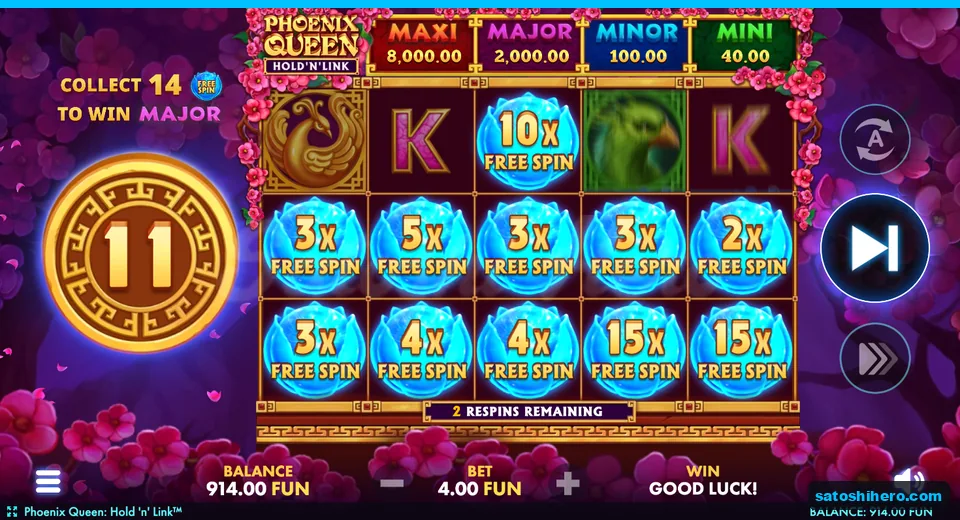
The final count sets both the jackpot threshold and the number of multiplier free spins. A late sphere can extend the round and improve both outcomes, yet random results decide its position and value. Wild Buffalo: Hold ‘n’ Link offers another take on persistent-symbol respins if that shared mechanic appeals to you.

Recommendation: Count spheres, not just remaining respins. Each new sphere restores all three respins, while the final total also sets up the free-spin phase.
Tested Bonus Result
I triggered three organic rounds, ending with 11, 12 and 13 spheres. The first arrived on spin 23, exactly when my balance reached its $914.00 low. Its locked-sphere phase led into 11 multiplier free spins and returned $332.00, equal to 83x my bet.
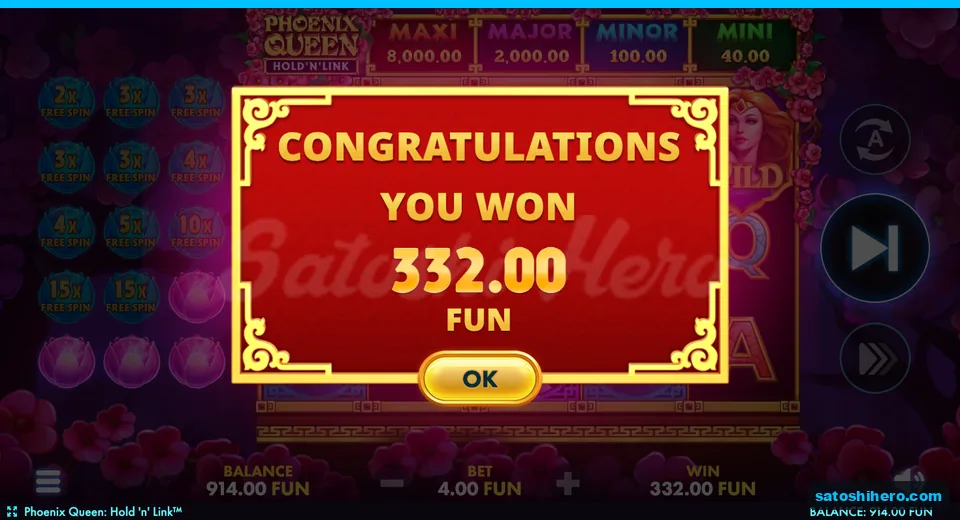
That $332.00 was the complete feature result, not the respin phase alone. You shouldn’t turn one strong round into an expectation for the next trigger. On one hand, the jump rescued my session immediately. The trade-off is that the earlier line wins hadn’t stopped the balance from falling.
Another sphere can reset the counter, yet the board can stop below a jackpot threshold. I think that tension works because the count affects two reward stages.
Sphere collection drives every later part of the bonus, but random outcomes decide how far each round progresses.
Multiplier Free Spins
Multiplier free spins begin only after Hold ‘N’ Link respins finish. You receive exactly one free spin for every collected sphere. This sequence differs from an ordinary retriggering bonus because its length comes directly from the locked board. I prefer that clear link, though it doesn’t guarantee stronger returns.
One Spin Per Sphere
My 11-sphere board produced 11 spins, while the other features produced 12 and 13. Collected spheres illuminated one at a time as the spins ran automatically. The triggering $4.00 stake remained active throughout each sequence.
More spheres give you more free spins and can qualify the round for a jackpot. They don’t create a retrigger meter, so you know the spin count before the sequence begins.
The presentation also makes the phoenix link collection easy to follow. You can watch each lit sphere hand its multiplier to one assigned spin, rather than guessing which value remains active.
Individual Multipliers
Each collected sphere owns one corresponding free spin. Its multiplier applies only to the win from that assigned spin. During my test, I saw 2x, 3x, 4x, 5x, 6x, 8x, 10x and 15x labels.
A high multiplier matters only if its spin produces a line win. You can watch a 15x sphere light up, but you shouldn’t treat that label as a payout by itself. Blank spins can waste the most exciting values, which gives this phase a sharp downside.
On one hand, the one-sphere-per-spin display feels more engaging than a generic counter. The trade-off is brutal when a strong tag meets empty reels. I still think the visible pairing makes every result easier to understand.
Each sphere becomes a separate chance, but its multiplier alone can’t create a win.
Four Jackpot Tiers
The jackpot ladder pays Mini 10x at 12 spheres, Minor 25x at 13, Major 500x at 14 and Maxi 2000x at 15. These are feature awards, not an overall win cap. You receive only one qualifying tier per round, and the following free spins remain separate. I like the clear thresholds, although the leap from Minor to Major is severe.
Sphere Thresholds
At my tested $4.00 stake, the awards translate as follows:
- Mini: 10x, or $40.00, after 12 spheres.
- Minor: 25x, or $100.00, after 13 spheres.
- Major: 500x, or $2,000.00, after 14 spheres.
- Maxi: 2000x, or $8,000.00, after all 15 spheres.
Reaching a higher threshold replaces the lower award rather than stacking with it. You should read the announced jackpot separately from the multiplier free-spin return. That distinction prevents a feature total from being mistaken for the fixed tier payment.

Footnote: A 15-sphere full board awards the 2000x Maxi, while 12, 13 and 14 spheres correspond to Mini, Minor and Major.
Mini In Testing
My second feature finished with 12 spheres and announced the Mini. The game added its $40.00 award before the multiplier free spins began. The entire feature returned $124.00, equal to 31x my bet.
You shouldn’t treat $40.00 and $124.00 as competing reports of the same result. One figure is the fixed jackpot, while the other includes everything from that bonus sequence. To be fair, the smaller Mini still gave the round a useful base before the assigned spins started.
At the end of a qualifying round, you can expect the tier announcement before the free-spin phase. Tiki Island: Hold ‘N’ Link offers an island-themed setting if you want another visual take on this feature family.
The sphere threshold fixes the jackpot, while the following spins can still change the complete feature payout.
Theme and First Impressions
A polished cherry-blossom fantasy frames a red-haired Queen, coloured phoenixes and glowing blue lotus spheres. Pink blossoms surround the reels against a purple night sky. The art looks rich without hiding essential information. I think the theme lacks novelty, but its execution feels confident.
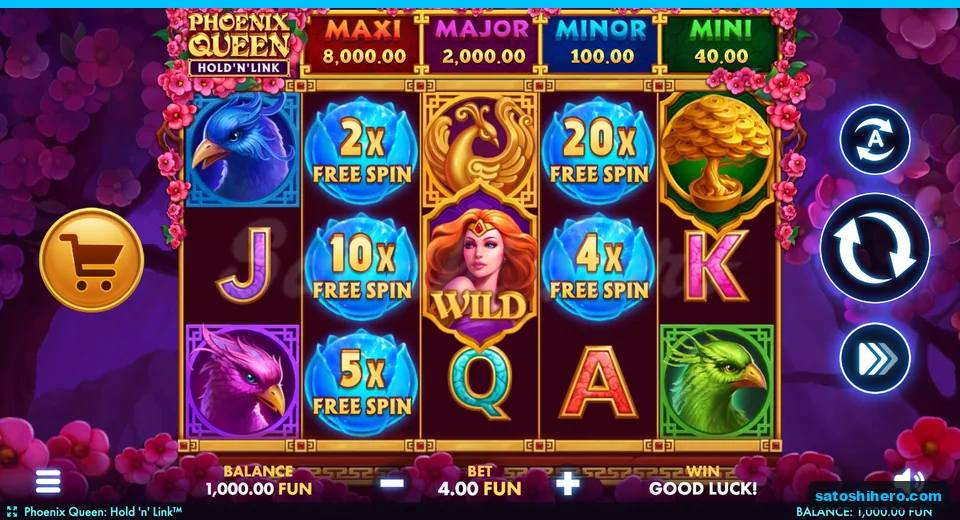
Blossom Fantasy Setting
Money-tree and phoenix symbols appear as ornate, gold-framed tiles. Blue lotus spheres display visible multipliers, while a four-tier jackpot bar sits above the grid. You can identify the feature symbols quickly despite the heavy decoration.
The phoenix-and-royalty idea won’t win originality awards. Still, the palette and polished tile work give it more character than a generic red-and-gold slot. Rubber Duck: Hold ‘N’ Link provides a more playful visual alternative if you find this fantasy styling too ornate.
Clarity On Screen
Regular symbols, sphere tags, jackpot tiers, stake and balance remain distinct. During Hold ‘N’ Link, your eyes should move between the sphere count and respin counter. In the next phase, you can shift attention to each illuminated multiplier.
That hierarchy becomes useful when the game changes modes. I never confused a regular Wild with a trigger sphere. The phoenix traditionally symbolizes renewal and rebirth, fitting the shift from locked respins into fresh chances.
The detailed presentation stays readable on a busy board, which is the design’s strongest quality.
Buy Bonus Access
The gold cart button left of the reels opens a Buy Bonus menu that can start Hold ‘N’ Link directly. It provides feature access without waiting for six spheres in the base game. You can see the route clearly, but the interface alone doesn’t justify choosing it. I prefer evidence over a sales pitch here.
Direct Feature Entry
Selecting the cart opens the feature purchase menu. I won’t invent a price, separate return figure or likely outcome because my observed interface only confirms direct access. You should judge the option by what the menu displays when you play.
Wild Buffalo: Hold ‘n’ Link Bonus Buy has a separate guide centered on purchasing access to this feature style. That comparison is useful if bonus entry interests you, but it doesn’t establish matching costs or returns.
Testing Limit
I didn’t purchase the bonus during my 100-spin session. You therefore can’t use this test as evidence for a bought result, and I have no sound basis to recommend that route. The three organic triggers provide the only observed feature evidence here.
That limit applies only to the purchase path. I tested the respins, multiplier free spins and Mini through natural triggers. You can rely on those outcomes without confusing them with an untested purchase.
Organic triggers provide the only tested basis for judging the feature in this guide.
How the Base Game Played
Ordinary spins recovered about $139.00 from the $400.00 staked outside my three bonus rounds. The line game played quietly, and its small wins didn’t support the profitable finish. You can follow it easily, but I found it thin beside the bonus action.
Ordinary Spin Results
I ran 99 spins on autoplay and played the final spin manually. Autoplay stopped whenever a bonus began, so I restarted it three times. Of the counted 100 spins, 21 produced a payment.
My largest ordinary spin returned $32.00, equal to 8x, on spin 61. The roughly $139.00 base return equals about 34.75x against 100x staked. You should read that figure separately from the three bonus results.
A base-win image came from four extra spins after the counted run. I kept those spins outside every session total. That boundary matters because you need a fixed sample before any result comparison means much.
Bonus Dependence
Three sharp Hold ‘N’ Link jumps carried the final profit. Without those features, the small line wins left a deep gap between money staked and money returned. The line game feels weak beside the bonus, though its familiar format remains easy to understand.
You shouldn’t assume another 100 spins can repeat three feature triggers. My result reflects a hot streak, not a normal trigger schedule. On one hand, the bonus architecture delivered memorable swings. The trade-off is a base game that offered little protection between them.

Caveat: This winning test depended on three features in 100 spins. Ordinary line wins recovered only about 34.75x from 100x staked, so don’t size your bankroll around the final profit.
The measured session rewarded feature luck rather than steady base-game returns.
RTP, Simulator and Our Test
According to Netgame, Phoenix Queen: Hold ‘N’ Link has a 96.26% theoretical RTP. That figure differs from our modeled illustration and my observed session result. You should use it as the game’s baseline, not a promise for any short run. I find the contrast especially important after such a profitable test.
Simulator Projection
The SatoshiHero Slot Simulator modeled 1,000 spins and produced a typical finish 45.3x the bet down. Its 5th-to-95th-percentile band stretched from 213.2x down to 149.6x up. That spread shows how sharply your result can move around the central figure.
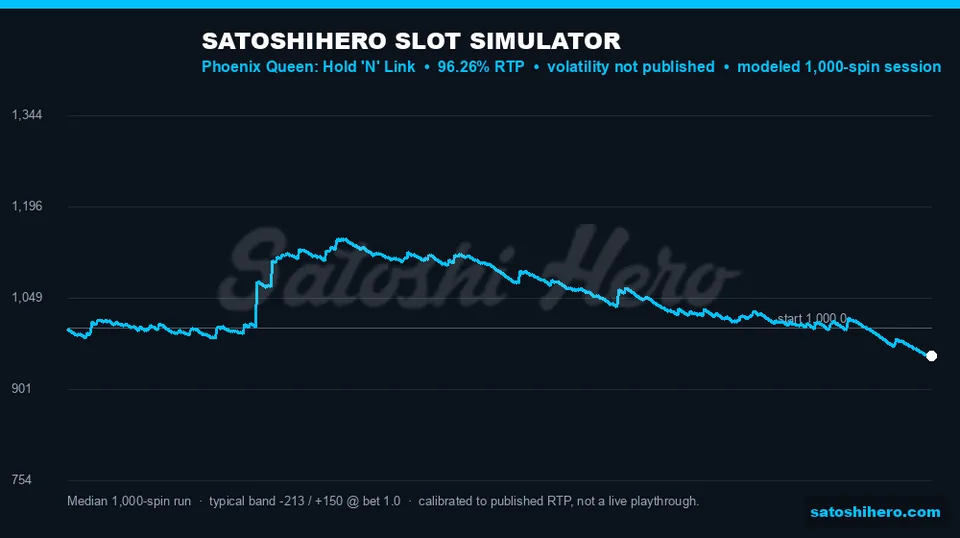
About 25 spins per 100 paid in the model. A feature-sized result appeared roughly once every 50 spins, but that frequency never becomes a countdown. You can’t infer that the next feature is due after 49 misses.
The simulator doesn’t read, copy or predict the game’s random number generator. It illustrates the published return through a model rather than recreating hidden game logic. I think that limit makes the range more useful than any single projected ending.
Our 100-Spin Session
I started with $1,000.00 at a $4.00 stake and finished with $1,393.00. My $393.00 gain equaled 98.25x the bet. The balance bottomed at $914.00 as the first feature began on spin 23, then peaked at $1,512.00 after spin 65.
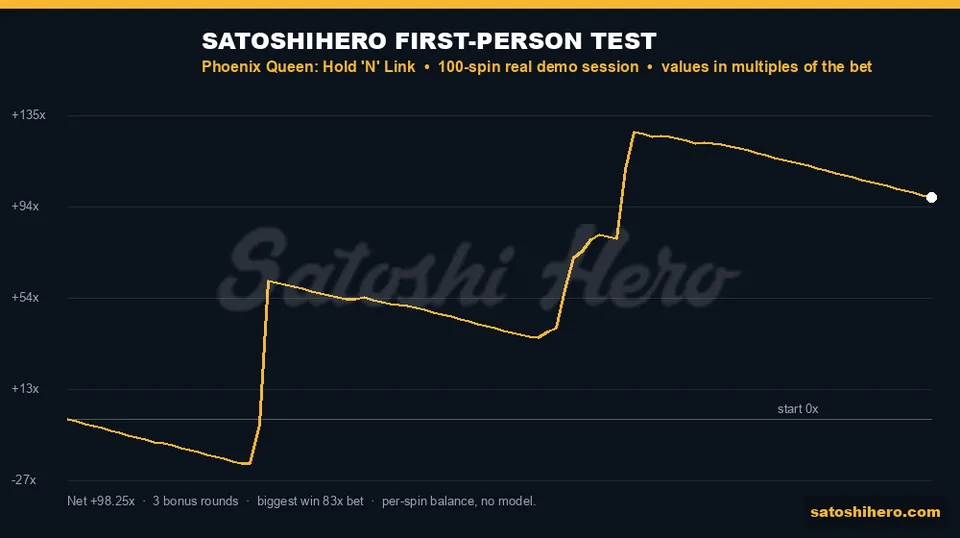
The three feature results shaped the entire curve:
- Spin 23: $332.00, or 83x, from 11 spheres.
- Spin 58: $124.00, or 31x, from 12 spheres, including the Mini.
- Spin 65: $198.00, or 49.5x, from 13 spheres.
The first round produced my largest win. Three features within 100 spins represented a hot streak, and you shouldn’t read that frequency as an expectation. Compared with the simulator’s wide band, you can see why one winning sample proves little about the next.
The 96.26% figure is Netgame’s theoretical return. One 100-spin result doesn’t alter it, while the simulator illustrates that figure without forecasting your session. A separate bonus-mode return can differ by design, so I won’t assign one without verified evidence.
The winning test demonstrates short-session swings, while the theoretical RTP remains the correct baseline for understanding the game.
Frequently Asked Questions About Phoenix Queen: Hold ‘N’ Link
How many paylines does Phoenix Queen: Hold ‘N’ Link have?
Phoenix Queen: Hold ‘N’ Link has 30 fixed paylines across a 5×3 grid. Matching symbols pay left to right, and only the highest win on each line counts.
What is the RTP of Phoenix Queen: Hold ‘N’ Link?
The theoretical RTP is 96.26%. My test finished 98.25x ahead because three bonuses carried the run, but one 100-spin result doesn’t change that figure.
How do you trigger Hold ‘N’ Link?
Six or more blue Free Spin spheres must appear together. They lock, three respins begin, and each new sphere resets the counter to three until it expires or all 15 positions fill.
What jackpots can Phoenix Queen: Hold ‘N’ Link award?
Mini pays 10x at 12 spheres, Minor 25x at 13, Major 500x at 14 and Maxi 2000x at 15. Only one tier pays, and my 12-sphere round collected the Mini.
How do free spins work in Phoenix Queen: Hold ‘N’ Link?
You receive one free spin per collected sphere. Each sphere’s multiplier affects only its assigned spin, and my three rounds provided 11, 12 and 13 spins.
What do the symbols pay in Phoenix Queen: Hold ‘N’ Link?
Five Queen Wilds pay 17.5x, the money tree 12.5x, golden phoenix 10x, coloured phoenixes 5x and cards 2.5x. The Queen Wild can’t replace Free Spin spheres.
Can you buy the bonus in Phoenix Queen: Hold ‘N’ Link?
Yes. The Buy Bonus menu can start Hold ‘N’ Link directly, but I didn’t purchase it and can’t offer an evidence-based recommendation for that route.
How did the 100-spin test go?
I began with $1,000.00, bet $4.00 and finished at $1,393.00. Three features created a 98.25x net gain, led by a $332.00, or 83x, result.
What does the 1,000-spin simulator project?
The typical modeled result finished 45.3x down, with a band from 213.2x down to 149.6x up. It illustrates the published RTP and doesn’t predict your session.
Final Word
Phoenix Queen: Hold ‘N’ Link stands out by turning each locked sphere into a later multiplier spin. Its main drawback is a thin base game that relied heavily on three feature jumps during my test.

My Verdict
Traditional payline fans with patience for bonus-led swings should try the demo before setting a real stake. Expect readable mechanics and exciting feature stages, but don’t treat my hot 100-spin run as typical.
I like how the collected spheres connect respins, jackpots and individual multiplier spins. I don’t like how little the ordinary game returned, even though the three organic bonuses pushed my balance sharply upward.
Phoenix Queen: Hold ‘N’ Link remains easy to understand despite its ornate design. Test notes and game details are checked regularly, so you can separate verified mechanics from one unusually strong session.

Pros:
 Clear feature chain: Locked spheres feed jackpots and multiplier spins without confusing rule changes.
- Strong RTP: The 96.26% figure gives the game a competitive mathematical base.
- Readable design: Counters, multipliers and jackpot tiers stay visible during busy sequences.
- Tested excitement: Three organic bonuses created distinct results and meaningful balance swings.

Cons:
 Thin base game: Ordinary wins recovered little of the amount staked.
- Feature dependence: My profitable finish relied on an unusually busy bonus run.
- Untested purchase: The available Buy Bonus lacks firsthand results in this guide.

Best For: Traditional line-slot fans who value a linked, multi-stage bonus over steady base-game returns. You need enough patience and stake control to absorb quiet spells without chasing my winning result.



































































Bets
All Bets
Game
Player
Date
Wager
Mult.Multiplier
Prize
 Mr. Crystalman: Hold 'N' Link
 Hidden
- 10:35:29
- 0.1×
- Mr. Crystalman: Hold 'N' Link
- Hidden
- 10:35:27
- 0×
- Egypt Fortunes: Bingo Bounty
 mdp0fxo
- 10:35:27
- 0.49×
- Mr. Crystalman: Hold 'N' Link
- Hidden
- 10:35:26
- 0×
- Almighty Diamonds: Hold 'N' Link
 novaone948
- 10:35:25
- 0×
- Mr. Crystalman: Hold 'N' Link
- Hidden
- 10:35:24
- 0×
- Egypt Fortunes: Bingo Bounty
- mdp0fxo
- 10:35:24
- 0×
- Royal Fruits 9: Hold 'n' Link
- Hidden
- 10:35:22
- 0×
- Luck of Panda: Bonus Combo
 josh1998
- 10:35:22
- 0×
- Rat King
 Hidden
- 10:35:20
- 0×