

Jump!
By pressing play, you agree that you are above legal age in your jurisdiction and that your jurisdiction allows online gambling.


Chasing a Jester Up the Neon Staircase
Trigger a Jester in the Jump! slot and its staircase board starts growing toward seven free games.
Jump! is a neon fruit slot from Habanero Systems with 98.13% RTP, medium volatility, and 500x maximum win potential. Five staggered reels provide 192 to 1,024 ways to win. My strongest moments came from Jester chains reaching free games, yet the 296.4x hot-test profit shows potential rather than a normal expectation.
Key takeaways
- Best play: No bonus buy appeared in my test, so your main target is a Jester chain reaching free games.
- RTP / volatility: Jump! slot has a 98.13% RTP and medium volatility.
- Max win: The official maximum win is 500x the bet.
- Risk note: Three feature rounds produced most of my 296.4x profit, revealing a concentrated hot session.
- Bankroll note: Size your stake for quiet stretches and failed chains, not six free-game triggers per 100 spins.

Table of Contents
- How Jump! Works
- Symbols and payouts
- Expanding Reels and Ways
- What expansion changes
- Jester Re-Spins
- Why continuations matter
- Seven Free Games
- Reading my results
- Neon Fruit-Machine Design
- A readable board
- Stacked Spin Tracker
- Changing the stake
- RTP, Volatility and Our Test
- Simulator Projection
- Our 100-Spin Session
- Jump! slot FAQ
- Final Take
How Jump! Works
Jump! slot is a five-reel ways-to-win game, not a fixed-payline slot. Matching symbols pay from the leftmost reel across adjacent reels, and only each symbol’s longest combination counts. Separate winning ways add together, so you can collect several symbol combinations from one result.
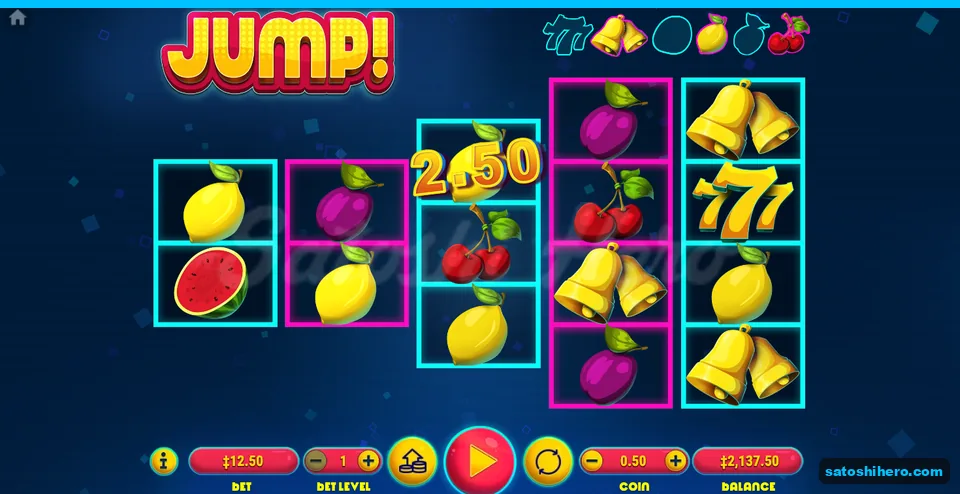
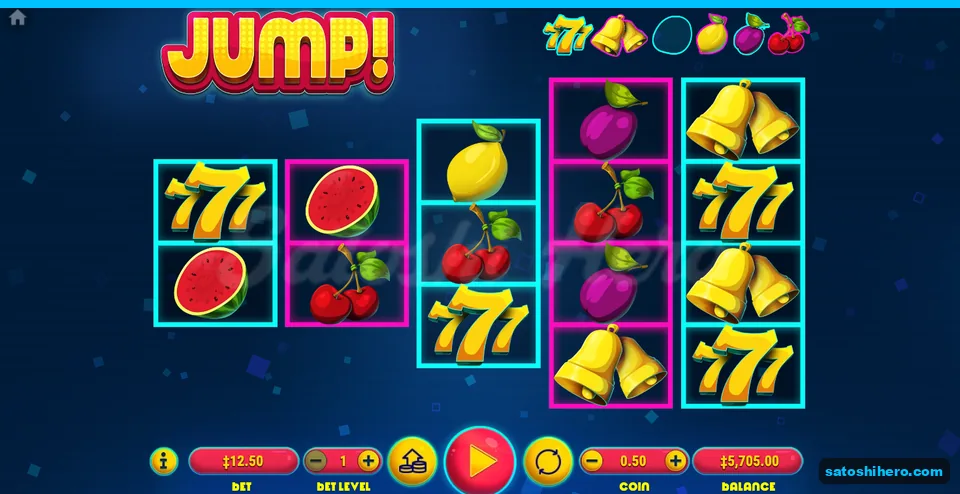
The starting board forms a staircase. Reels one and two show two rows, reel three shows three, while reels four and five show four. You can see the logic quickly, even though the uneven shape looks unusual at first.
| Symbol | Five | Four | Three |
|---|---|---|---|
| Red Seven | 20x | 8x | 0.6x |
| Golden Bells | 12x | 4.8x | 0.4x |
| Watermelon | 8x | 2.8x | 0.4x |
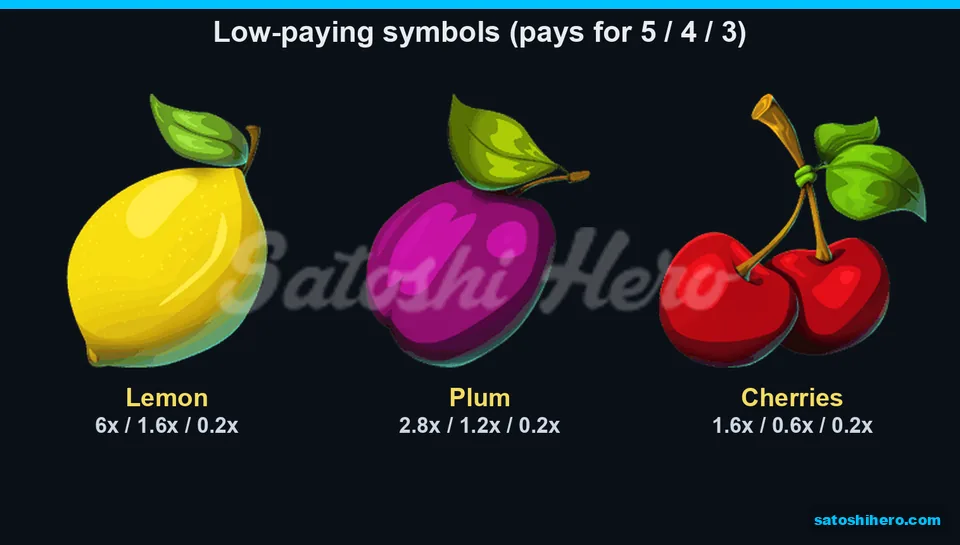
| Lemon | 6x | 1.6x | 0.2x |
| Plum | 2.8x | 1.2x | 0.2x |
| Cherries | 1.6x | 0.6x | 0.2x |
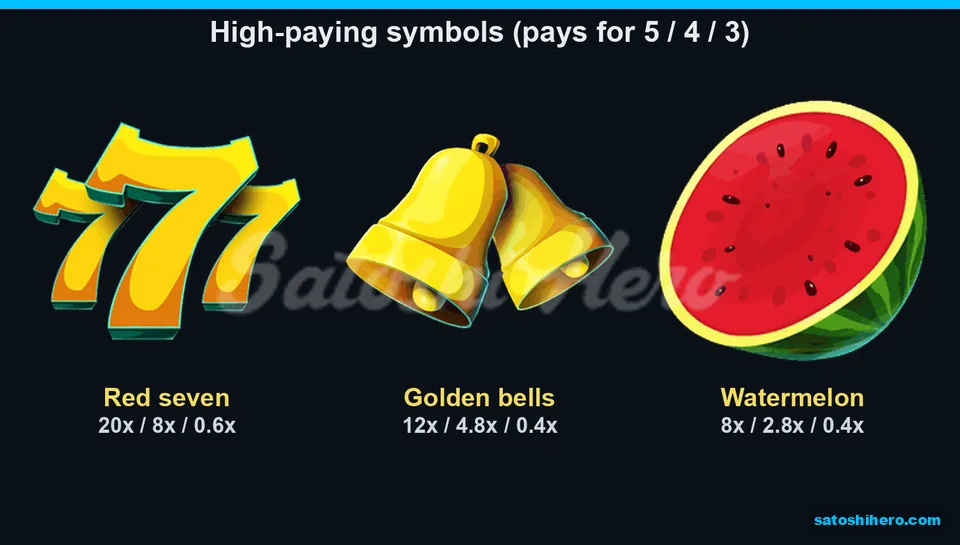
The pay panel displayed play-money amounts at my $12.50 wager, so I divided every award by that bet. My smallest logged win was $2.50, equal to 0.2x. That result matched the listed three-symbol return for each low symbol and gave me a useful check on the scale.
A Jester substitutes for every regular symbol but pays nothing alone. Only one can appear on the base-game screen, which keeps its role focused on starting re-spins.
Symbols and payouts
Desktop and mobile layouts keep the same controls and readable staircase, so you don’t lose the board logic on a smaller screen.

Factoid: The smallest win I logged was 0.2x the bet, exactly matching the lowest listed three-symbol payout.
You get a simple paytable, but the shorter reels make it feel less static. Once they expand, you have more combinations in play and a much livelier board.
Expanding Reels and Ways
The game starts with 192 ways and reaches 1,024 ways once every reel stands four rows tall. Each opened row multiplies possible symbol combinations, but these aren’t selectable paylines. If you think in lines, you’ll misread what the growing board actually changes.
Every paid spin costs $12.50 as part of the game’s wager setup. Wager size and bet level combine into one bet configuration, while wins use the selected bet level. My demo opened with a $0.50 denomination, bet level 1, and a fixed $12.50 wager, producing the $12.50 bet shown on screen.
What expansion changes
Changing the wager size or bet level changes your total wager rather than any line count. That distinction matters because all reported results use bet multiples, not play-money amounts. You can compare a 0.5x return with a 20x return without tying either result to one stake.
The $2,000.00 opening balance covered 160 default bets, enough to show several board-growth attempts. That runway mattered because six of my 12 Jester chains ended early. If you watch only successful expansions, you miss how often the staircase can stop before reaching full size.

Tactic: Compare results in bet multiples rather than the demo’s dollar balances. A 0.5x, 20x, or 164.4x return then means the same at any stake.
An early re-spin chain matters because the sticky Jester stays active while new rows open. More ways create more possible matching routes, yet they don’t promise a paying result. You still need symbols to connect from the first reel across adjacent reels.
I like how the expansion remains visible instead of hiding behind a counter. You can watch the opportunity grow, but you shouldn’t mistake a larger board for secured value.
Jester Re-Spins
Any Jester appearing in the base game starts a re-spin sequence. The triggering wild sticks, then jumps to an adjacent block whenever the relevant reels share the same height. On each re-spin, the rightmost reel below four rows gains one row.

A paying result grants another re-spin, so continuation depends on wins rather than a fixed round count. No second Jester can appear during the sequence, and every re-spin retains the triggering wager. You need four re-spins to complete the board, which makes each continuation feel useful rather than cosmetic.
I triggered the feature 12 times across 100 paid spins. Six chains stopped before reaching the free games and returned 0x, 2.8x, 0.4x, 0x, 0x, and 1x. Three of those Jesters returned nothing, while only one failed chain cleared the original bet by much.
Why continuations matter
That pattern gave me the clearest warning in the whole test. A Jester creates potential, not guaranteed value, and half my observed chains missed the main feature. You shouldn’t treat its arrival as a major win or raise your stake after one short successful chain.
The six failed chains totalled little compared with any qualifying round. That contrast made every paying re-spin feel more important than the opening wild. You need the chain to survive four steps, so one or two expansions can still leave you with a weak return.
The continuation rule matters more than the initial trigger. If a re-spin pays, you gain another chance to open a row while the wild keeps moving. When it misses, the promising board stops immediately, which can feel abrupt.
My opinion is mixed but positive: the jump animation gives every continuation purpose, yet weak chains can vanish quickly. You should judge the feature by whether it keeps paying, not by the first Jester alone.
Seven Free Games
Seven free games begin after four re-spins expand every column to four rows. The final short reel gains its last row as the feature starts, and the original Jester remains sticky. It jumps to an adjacent block on every free spin, while a second Jester can’t appear.
All free spins use the wager from the triggering paid game. I reached them six times, always through a re-spin chain. Including those preceding re-spins, the rounds returned 16.6x, 19.6x, 19x, 44.2x, 164.4x, and 122.4x.
Reading my results
The strongest cluster arrived late in my counted session. Spin 65 returned 44.2x, spin 70 delivered my 164.4x high, and spin 78 added 122.4x. Those three rounds caused the sharp balance climbs and supplied nearly all the meaningful upside.
The first three qualifying rounds were far less dramatic, despite clearing the same four-step entry path. That spread is important when you assess a trigger. Reaching seven free spins opened the better opportunity, but it didn’t make every round resemble my three late surges.

Discovery: Every tested free-game round returned at least 16.6x, but six rounds can’t establish the feature’s typical return.
Six triggers in 100 paid spins felt unusually generous and don’t create an expected hit rate. You still have to survive the full four-re-spin build-up, and half my Jester chains stopped before that point. Hot to Burn – 7 Deadly Free Spins offers another fruit theme centred on free spins, whereas Jump! slot requires this expanding chain first.
What stands out is the difference between qualifying and failing. You can watch the board approach full size, yet one blank re-spin ends the attempt. The free games gave me the best returns, but each one demanded a successful build-up.
Neon Fruit-Machine Design
Jump! uses classic fruit symbols inside bright neon frames built around its staircase board. Gold sevens, bells, lemons, plums, cherries, and watermelons sit against a deep-blue background. Cyan and magenta edges make the uneven reel heights easy for you to read.
A grinning Jester hat supplies the main character and the only wild. Its movement draws your eye across the expanding reels, which helps connect the visuals with the feature rules. You can follow board growth without studying a separate meter or reopening the pay panel.
A readable board
Above the reels, six symbol icons form the Stacked Spin tracker. Their lights remain visible between paid spins, so progress never feels hidden. The arrangement also balances the staggered board rather neatly on both desktop and mobile screens.
I found the color coding clear during autoplay because opened rows changed the board silhouette immediately. Even at a glance, you can separate tracker progress from reel expansion. That clarity matters when both feature paths advance through different events during the same session.
The fruit theme won’t win originality awards, and I wouldn’t choose this game for story or atmosphere. Still, the neon treatment communicates the core mechanic better than a busier setting could. Hot To Burn Multiplier is another option if you enjoy modern visual takes on classic fruit-machine imagery. Journey to the West takes a different thematic direction from the neon fruit-machine design.
Some players search for a jackpot jump slot machine, but that phrase misrepresents this design. The game builds toward expanding features rather than a jackpot-led mechanic, so you should focus on the Jester and board state. Its shape, not the familiar fruit, gives the presentation a clear identity.
Stacked Spin Tracker
The tracker records winning regular symbols, and lighting all six secures a Stacked Spin on the next paid spin. Each winning symbol lights its matching icon above the reels. Progress stays visible and saves separately for every bet configuration.
When the tracker completes, five copies of one randomly chosen regular symbol appear anywhere before the reels land. The selection excludes the Jester wild. No icons light during that special spin, and the complete tracker resets once the feature finishes.
Changing the stake
Stake changes have a practical effect here. Altering wager size or bet level moves you to the saved progress attached to that configuration. You don’t erase the earlier record, but you stop viewing it until you return to the matching setup.
This rule makes consistency more useful than frequent wager changes. If you move between configurations, you split visible progress across separate records. Check the six icons first, then decide whether a new stake matters more than continuing the tracker already on screen.
I watched several icons light during my 100 counted spins, yet the row never completed. That means my description comes from the game rules, not a triggered result. I can’t judge its return, estimate its hit rate, or claim that one chosen symbol appears more often.
This feature adds a slower target beside the immediate Jester chains. I like seeing progress survive between spins, though separate records can discourage casual stake changes. You should check the tracker before adjusting your bet, especially when several icons already glow.
The surprise here is how quietly it develops while re-spins grab attention. Jump! 2 is the direct sequel for readers curious about where the series goes next. In this game, the tracker provides useful structure, but my test couldn’t establish the completed feature’s value.
RTP, Volatility and Our Test
The official profile combines a 98.13% RTP, medium volatility, and a 500x maximum win. That theoretical return looks unusually strong, while the ceiling feels modest beside feature chains that can control an entire session. You shouldn’t read medium volatility as evenly spread results.
Choose a bet that can absorb ordinary low returns and Jester chains that end early. My balance fell before three large rounds changed everything, so raising your stake after this profitable test would be a poor reading.
Simulator Projection
The modelled 1,000-spin session ended with a median loss of 25.4x the bet. Its central 90% range stretched from 200.7x down to 190.2x up, showing broad variation around that midpoint. You should read those endpoints as a range of simulated outcomes, not targets.
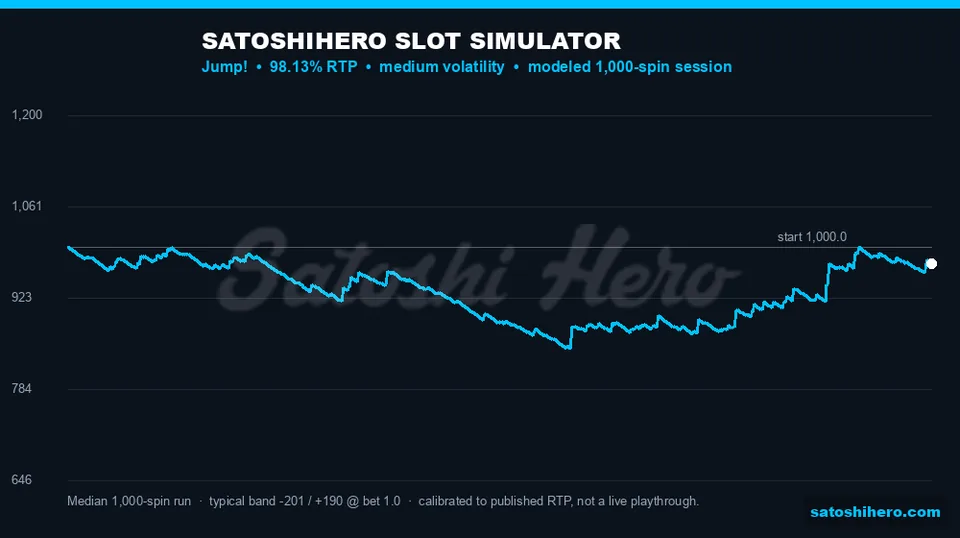
About 25% of spins returned something in the model. A feature-sized result appeared approximately once per 48 spins, while a very large result appeared around once per 12,658 spins. The simulator used one bet unit to keep results comparable across stake sizes.
Those frequencies don’t predict your next spin, trigger, or session. A run can cluster features or miss them for long stretches, and the model doesn’t create a countdown. I find the wide central range more useful than the median alone because it shows how far ordinary sessions can separate.
Use the projection to plan a stake, not to time a feature. The 200.7x downside edge shows why a short bankroll can struggle, even with an attractive theoretical return. Its 190.2x upside edge also shows that a profitable modelled run needn’t approach the game’s ceiling. Neither endpoint tells you how smoothly the balance travelled.
Our 100-Spin Session
My session finished at $5,705.00, producing a 296.4x profit across 100 paid spins. I started with $2,000.00 and used the $12.50 default wager throughout. That balance supplied 160 starting bets.
I played the opening spin manually, then ran autoplay batches of 50, 30, and 10. The stop-on-free-games setting stayed disabled, allowing each feature to play through. Nine final manual spins brought the count to exactly 100 paid spins, while later screenshot spins stayed outside every result.
Thirty-one paid spins returned something, but most ordinary awards were small. My balance reached its low near spin 28 at $1,712.50, equal to 23x down. The largest non-feature result paid only 1.2x, which explains why the early stretch felt flat despite regular small hits.
That early low matters because the later finish can hide the session’s weaker first phase. Before the large features arrived, small returns couldn’t offset repeated $12.50 wagers. If you had judged the game near spin 28, the same test would have looked far less remarkable.
Spin 65 returned 44.2x and began the sharp recovery. Spin 70 paid 164.4x, including its re-spins and free games, moving my balance to $4,527.50. Another 122.4x round on spin 78 created the $5,972.50 session peak before the balance eased back.
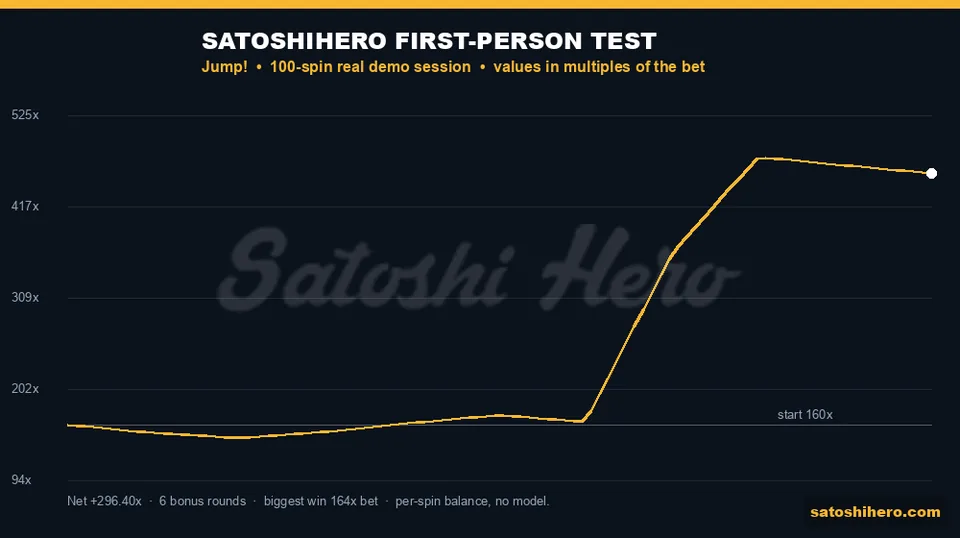

Proceed Carefully: My 100-spin result was a hot run. Three rounds produced most of the profit, while the biggest ordinary spin returned just 1.2x.
Twelve re-spin triggers and six free-game rounds made this a clear outlier against the model’s approximate feature-sized frequency. You can see the game’s upside concentration in those three jumps, but you can’t treat 296.4x as a repeatable expectation. The finish shows potential, not a normal result.
The 98.13% figure is the operator’s published theoretical return, and one live session doesn’t alter it. Simulator frequencies describe a model rather than fixed trigger intervals. Feature behaviour and feature-specific returns can differ slightly from the base-game distribution by design.
Frequently Asked Questions
What are the RTP and maximum win of the Jump! slot?
Jump! slot has a 98.13% RTP, medium volatility, and a 500x maximum win. One feature chain can still decide a short session despite the medium rating, as my test demonstrated.
How many ways to win does the Jump! slot have?
The game starts with 192 ways and expands to 1,024 ways. Its reel heights begin at two, two, three, four, and four rows. Wins run left to right across adjacent reels, and only the longest combination for each symbol pays.
What did the 1,000-spin Jump! slot simulator show?
The model produced a median loss of 25.4x, with its central 90% range spanning 200.7x down to 190.2x up. It illustrates possible variation and can’t forecast your future session.
How did the Jump! slot perform in the 100-spin test?
I finished 296.4x ahead after 31 paying spins. My largest round returned 164.4x through re-spins and free games. This was an unusually hot result because three feature rounds generated most of the profit.
How does the Jump! slot re-spin feature work?
A base-game Jester starts the sequence, sticks, and jumps between adjacent blocks as matching reel heights allow. Each re-spin expands the rightmost short reel, while every win continues the sequence. I recorded 12 triggers across 100 paid spins.
How do you get free games in the Jump! slot?
Four consecutive re-spins must expand every column before seven free games begin. My six qualifying rounds, including their preceding re-spins, returned between 16.6x and 164.4x. That frequency came from one hot session.
What does the Jester wild do in the Jump! slot?
The Jester substitutes for all regular symbols but pays nothing alone. Only one appears on the base-game screen, and it remains sticky while jumping during re-spins and free games.
What is the Stacked Spin in Jump!?
Winning regular symbols light six tracker icons. Completing the tracker secures a next-spin feature with five pre-placed copies of one random regular symbol. My tracker didn’t complete during the 100-spin test.
Final Take
Jump! stands out through a staircase board that turns every continued Jester re-spin into visible progress. The strong return attracts attention, but the modest ceiling limits its strongest chains.

My Read
Play it for expanding-reel tension and linked features, not jackpot-sized prizes. Expect small ordinary returns and accept that a promising Jester chain can stop before the free games.
I liked how spins 65, 70, and 78 transformed my balance after a subdued opening stretch. I didn’t like seeing half the Jester chains fail before qualification, including three that returned nothing. That contrast made the test exciting but highly concentrated.
The Jump! slot rewards feature hunters who value visible progress. Play free or for real here on SatoshiHero, keep your stake steady, and note that this guide is checked regularly.

Pros:
 Outstanding RTP: The theoretical return gives long sessions an unusually attractive mathematical profile.
- Visible progression: Expanding reels show exactly how close you are to free games.
- Linked features: Sticky Jester re-spins create clear tension before every continuation.
- Simple paytable: Six regular symbols keep wins quick to understand.

Cons:
 Modest ceiling: The 500x cap limits the reward from strong feature chains.
- Empty triggers: Three observed Jester sequences returned nothing before stopping.
- Slow tracker: My 100 paid spins never completed the Stacked Spin meter.

Best For: Expanding-board fans and patient fruit-slot regulars get the clearest appeal here. You need comfort with failed re-spin chains, concentrated returns, and a lower prize ceiling.
Similar Games


































































Bets
All Bets
Game
Player
Date
Wager
Mult.Multiplier
Prize
 Luck of Panda: Bonus Combo
 mike_721
- 09:11:06
- 3.75×
- Luck of Panda: Bonus Combo
 Hidden
- 09:11:06
- 0×
- Egypt Fortunes: Bingo Bounty
- mdp0fxo
- 09:11:06
- 3.3×
- Big Banker Bonanza
- nina87
- 09:11:05
- 0×
- 4 Hot Chillies
- Hidden
- 09:11:02
- 2×
- Piggy Bankroll: The Big Stash
 davidm5
- 09:11:01
- 0×
- 4 Hot Chillies
- Hidden
- 09:11:00
- 0×
- Piggy Bankroll: The Big Stash
- davidm5
- 09:10:57
- 0×
- 4 Hot Chillies
- Hidden
- 09:10:57
- 0×
- Piggy Bankroll: The Big Stash
- davidm5
- 09:10:56
- 0×