

Take The Bank
By pressing play, you agree that you are above legal age in your jurisdiction and that your jurisdiction allows online gambling.


Take The Bank Guide: Bank-Heist Spins With a Countdown Twist
According to Betsoft, Take The Bank turns a cartoon bank raid into a 10-spin countdown where robbers become locked bombs before flipping into wilds. Take The Bank is a medium volatility slot from Betsoft on a 5×4 grid with 75 paylines, 96.08% RTP and 225x max win potential. My demo opened at $1.20 with a $1,000.00 balance, then hit free spins on the first spin for $56.70 before finishing the 100-spin test $4.68 down.
Snapshot
The 225x cap feels modest beside many bonus-buy slots, but the countdown gives the base game more shape than a plain line spinner. You can play the demo or real mode on SatoshiHero, and the best read here comes from watching full countdown cycles, not single spins.
Key takeaways
- Best bonus: The Buy Bonus jumps to 15 free spins and costs 27x, 50x or 95x the bet, depending on whether you pick 5, 7 or 10 wilds per spin.
- RTP / volatility: The official RTP is 96.08%, and the volatility is medium.
- Max win: The maximum win is 225x, which sits low for a bonus-buy slot.
- Risk note: My first spin triggered free spins for $56.70, but the 100-spin session still ended $4.68 down.
- Bankroll note: The $1.20 test looked mild, while the 1000-spin model showed a median $54.60 loss at the same stake.

Table of Contents
- How Take The Bank Works
- Grid and lines
- Symbol values
- Master Bomb Counter
- Countdown rhythm
- Bomb payoffs
- Theme & First Impressions
- Heist setting
- Visual clarity
- Free Spins
- Trigger and setup
- Test result
- Buy Bonus Options
- Three price tiers
- Bankroll fit
- Double Up Gamble
- Half or all
- When to skip
- What the 100 Spins Taught Me
- Early feature hit
- Base-game drift
- RTP, Volatility & Our Test
- Simulator projection
- Our 100-spin session
- Frequently Asked Questions About Take The Bank
- Closing Thoughts
How Take The Bank Works
Take The Bank works as a 5×4, 75-payline slot where wins pay left to right on adjacent reels. Only the highest win on a line pays, so you’re chasing clear line matches rather than ways, clusters or scattered pay-anywhere hits.
Grid and lines
The layout uses five reels and four rows, with 75 fixed paylines running across adjacent reels. You’ll notice the game keeps the screen tidy, even when robber bombs start locking into place. The layout stays easy to read on desktop and mobile because the reels, counter and controls remain clear.
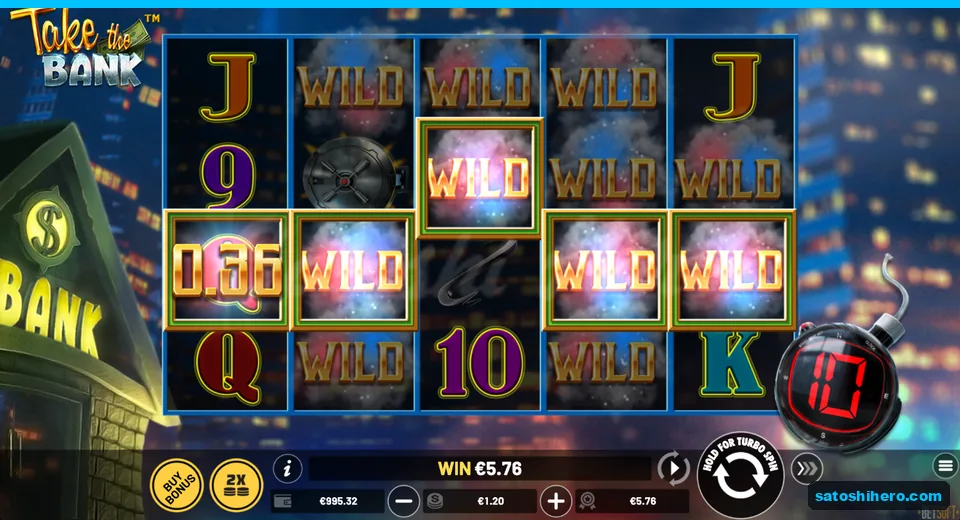
A real base-game line win shows how the wilds help connect symbols across the grid. In my test, the best base moments came when the countdown finished with bombs already waiting in useful spots. That gave the line wins a small burst of tension, even when the amounts stayed controlled.

Fast Fact: This is a true 75-payline slot, not a ways, cluster or pay-anywhere game.
Symbol values
The paytable scales with your stake, so I quote symbols as bet multiples. The diamond sits at the top of the regular symbols and pays 3x for five, 0.6x for four, 0.2x for three and 0.05x for two. At my $1.20 stake, five diamonds paid $3.60.
Gold bars pay 1x for five, 0.3x for four and 0.15x for three. The cash stack pays 0.9x, 0.25x and 0.15x across the same match lengths. Those two symbols matter because they can turn a wild conversion into a cleaner mid-line hit.
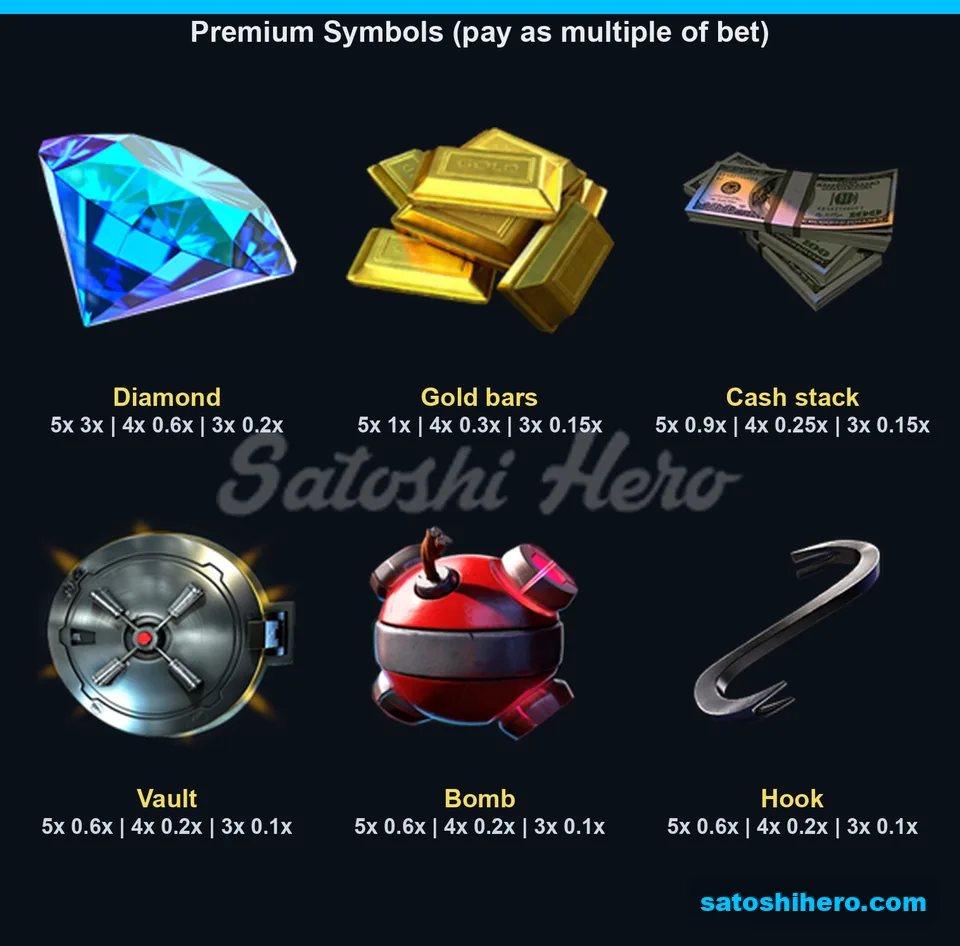
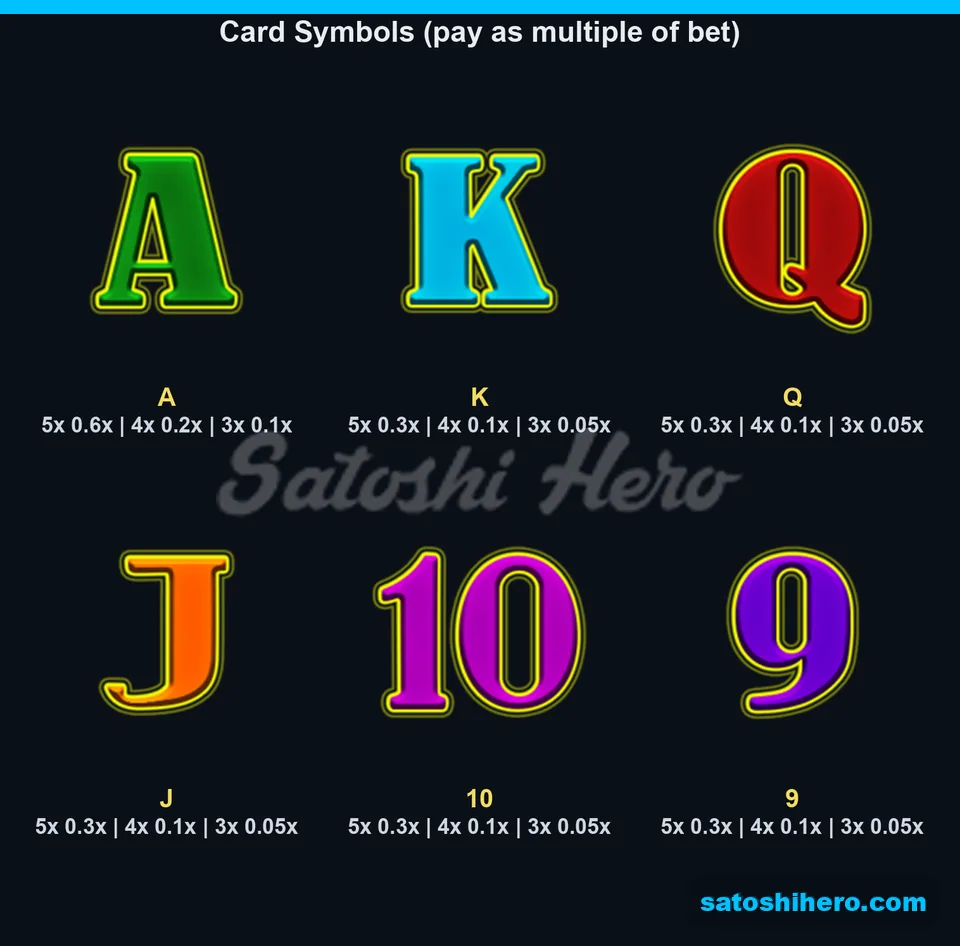
The vault, red bomb and hook each pay 0.6x for five, 0.2x for four and 0.1x for three. A pays the same. K, Q, J, 10 and 9 each pay 0.3x for five, 0.1x for four and 0.05x for three, so the card symbols mostly keep smaller wins ticking.
The wild replaces every symbol except the police car and robber. Five wilds pay like five diamonds, which makes the countdown more important than the base symbol ladder. The robber doesn’t pay on its own, since it changes into a wild bomb. The police car acts as the scatter, and it lands only on reels 2, 3 and 4.
That symbol logic makes the game easy to follow. You don’t need to chase hidden rules, because every special symbol has a clear job.
Master Bomb Counter
The Master Bomb counter is the core base-game mechanic because it turns locked robber bombs into wilds at the end of each 10-spin cycle. You should watch the counter as closely as the reels, since quiet spins can still build the next payoff.
Countdown rhythm
The game plays in 10-spin rounds, tracked by the stopwatch bomb to the right of the reels. Each spin moves the counter down from 10 toward 0. Whenever a robber lands, the game converts it into a locked wild bomb that stays in position.
At zero, all locked bombs detonate and become wilds. The counter then resets to 10, and those wilds clear on the following spin. That rhythm gives the base game a small story arc, which I like more than waiting passively for scatters.

Tip: Judge the base game over full 10-spin countdown cycles, because a few quiet spins may just be setting up locked bombs.
Bomb payoffs
Early spins in a round feel like setup, especially when robbers land in awkward places. The tension comes later, when several bombs convert together and suddenly create new line routes. In my session, that usually meant small or medium line wins, not giant swings.
The final base spin gave a neat example. Wild bombs helped create a $5.76 win, which felt fair rather than flashy. You might find that satisfying if you like seeing how a result builds, but big-win chasers may find the ceiling too low.
The counter gives the base game structure even when wins stay modest. That’s the game’s strongest mechanical idea.
Theme & First Impressions
The theme is a clear bank-heist setup, and its best trait is how closely the visuals support the countdown mechanic. Betsoft builds the scene around a night city, a leaning bank and symbols that all point back to the same ticking-bomb idea.
Heist setting
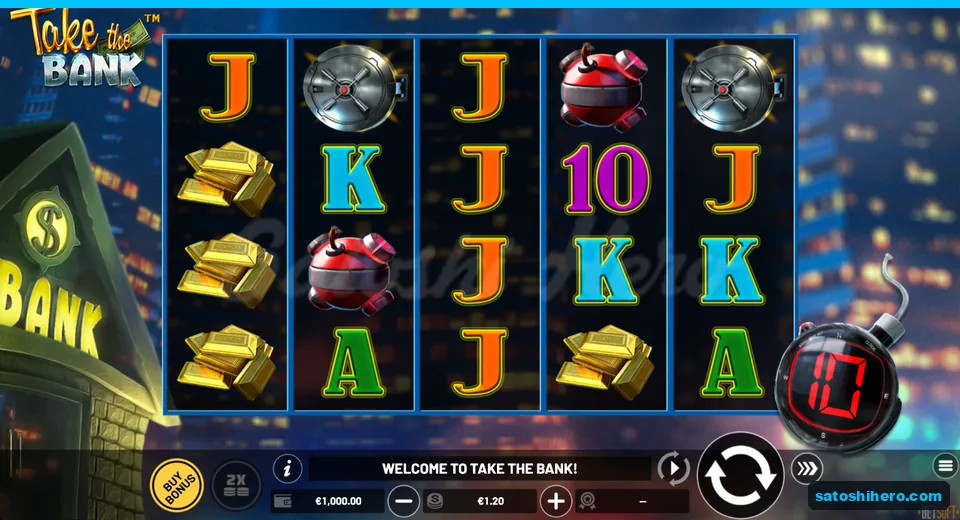
The reels sit in front of a night-time city skyline, with a bank building leaning in from the left. A striped-shirt robber, police car and stopwatch bomb carry the story without making the screen messy. You can understand the game’s logic before opening the paytable.
The theme won’t win originality awards, and I don’t think it tries to. Its real value comes from function. Take the Shot gives action-theme fans another Betsoft-style comparison point, while this game leans harder into a countdown heist rhythm. The Hive! gives the same-provider list a different tone when you want a brighter theme after the darker bank setting.
Visual clarity
At the $1.20 stake, the opening screen showed a $1,000.00 balance and the counter sitting at 10. That setup made the first few spins easy to track. You always know whether you’re early in the cycle or close to the bomb conversion.

Trivia: The heist theme isn’t just decoration; the robber, police car and ticking bomb all connect to the main mechanics.
The controls also stay readable, which helps when you’re watching both paylines and the counter. I like that the game doesn’t bury the mechanic behind visual clutter. The design works because it makes the countdown easier to understand.
Free Spins
Free spins trigger when three police cars land on reels 2, 3 and 4, awarding 15 spins with moving scattered wilds. This was the highlight of my test because it landed immediately and gave the session its main lift.
Trigger and setup
Police cars only appear on the middle three reels, so the trigger has a specific shape. Land all three and you get 15 free spins. The Master Bomb counter pauses during the round, which keeps the base-game cycle waiting for your return.

Each free spin uses 5, 7 or an epic 10 wilds scattered anywhere on the reels. Those wilds move to new positions every spin, so the bonus feels active without needing extra pick screens or layered meters. Double Up doesn’t appear after free spins, which keeps the feature clean.
Trivia: Police scatters only land on reels 2, 3 and 4, so the trigger is a specific middle-reel chase rather than a full-reel scatter hunt.
Test result
My first paid spin triggered the feature, which is a fun way to start any test. The round paid $56.70 at a $1.20 stake, or about 47x the bet. It lifted my balance to $1,055.50 before the second paid spin.
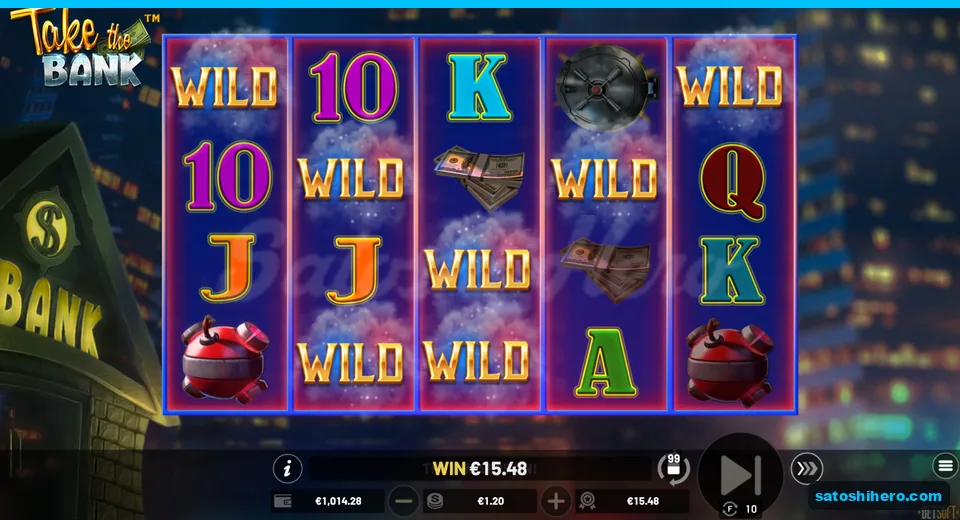
The scattered wilds made every spin feel busy, yet the total still matched a medium-volatility feel. I didn’t see the bonus threaten the 225x cap, and that’s important context. Take Olympus may interest readers who like feature-led slots, though this one relies on moving wilds and a paused counter rather than a broader bonus structure.
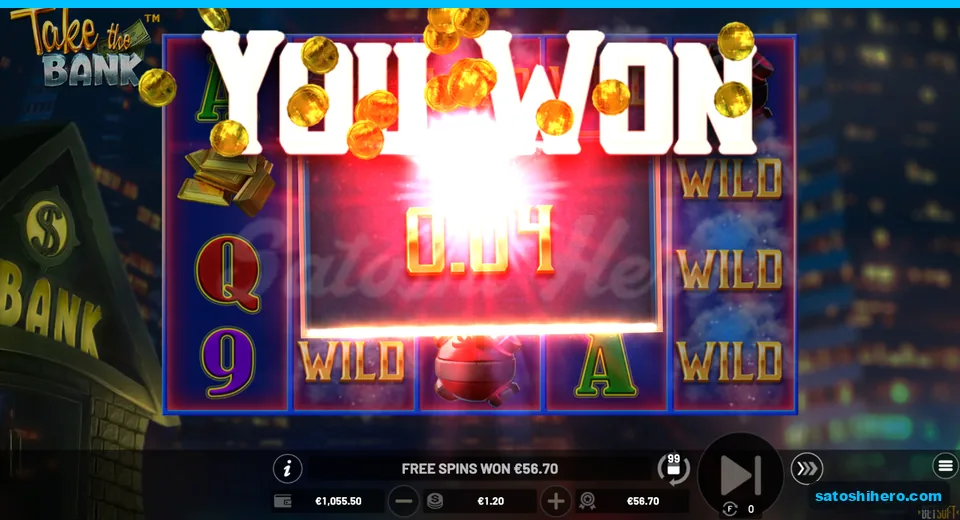
Free spins gave the session its best moment. They also showed how the game can feel exciting without pretending to be a huge multiplier hunter.
Buy Bonus Options
The Buy Bonus lets you skip straight to the 15 free spins, and the price depends on how many wilds you want per spin. I didn’t buy any bonus during this test, but the menu tells you plenty about the game’s risk profile.
Three price tiers
At my $1.20 stake, the 5-wild option cost $32.40, equal to 27x the bet. The 7-wild option cost $60.00, or 50x. The 10-wild option cost $114.00, which equals 95x the bet.
Those prices are simple, and I like that the game links cost directly to wild count. You aren’t guessing what the extra money changes. Take The Kingdom makes sense as another “Take” title to compare for theme and feature feel, but this heist game prices its free-spin buys very bluntly.
Bankroll fit
You shouldn’t pick a tier just because the top option sounds more exciting. The 27x buy gives the most accessible route into the feature. The 95x buy takes a serious bite from your bankroll, especially beside a 225x maximum win.

Alert: The top buy costs 95x your stake while the whole game caps at 225x, so don’t treat it like an unlimited-upside bonus hunt.
Set a limit before opening the buy menu. I’d rather test natural triggers first, because the base game has its own countdown rhythm. The buy option adds control, but it also makes stake discipline more important.
Double Up Gamble
Double Up is an optional post-win gamble that can double half or all of a standard win on a coin-spin guess. It doesn’t drive the main game, and I’d treat it as a side tool rather than part of the slot’s core value.
Half or all
The Double Up button appears after a standard win. You can gamble half or all of that win, then a correct coin-spin guess doubles the gambled stake. If you want to stop, Collect banks the amount.
You can repeat the gamble, which adds a sharp risk curve to even small wins. The feature doesn’t appear after free spins, so bonus totals stay protected from that coin-spin choice. I like that separation, because the free-spin round already has enough movement from the wilds.
When to skip
I never used Double Up during my test. The slot already has a modest 225x cap, so coin flips can burn a useful base-game hit faster than they improve the experience. If you’ve just landed a clean line win, collecting often feels better than chasing extra variance.
You might enjoy the gamble if you like quick risk decisions. I don’t think the game needs it. Double Up adds choice, but the slot makes sense without it.
What the 100 Spins Taught Me
My 100-spin test showed a classic medium-volatility pattern: one strong early feature, then a slow base-game giveback. The result felt steadier than the bonus-buy menu might suggest, which surprised me a little.
Early feature hit
I played 100 spins at $1.20 from a fresh $1,000.00 balance. The very first spin triggered 15 free spins, and they paid $56.70. That pushed the balance to $1,055.50 before I had played a second paid spin.
That start made the session feel generous, but it didn’t stay that way. You can’t read a slot from one feature hit, especially with a medium volatility profile. The Exterminator offers a different theme for readers who compare measured session feel, while this heist test came down to early bonus value and later base drift.
Base-game drift
I finished at $995.32, which meant a $4.68 loss overall. The base game gave back $60.18 over the other 99 spins. Only 17 of my 100 spins paid, and my biggest single base-game win outside free spins was $17.52.
No second free-spin trigger arrived. The Master Bomb counter kept cycling through 10-spin rounds, and the wild bombs mostly created small line wins when they went live. The final base spin’s $5.76 win summed up the feel well: active, readable and not explosive.
That pattern matters for bankroll planning. An early 47x feature didn’t lock in a profit, because the base game slowly pulled most of it back. This test made the slot feel steadier than its buy menu suggests.
RTP, Volatility & Our Test
Take The Bank has 96.08% RTP, medium volatility and a 225x maximum win, so expectations should focus on steadier feature play rather than giant jackpot-style outcomes. The math matches my test feel: readable, medium-paced and capped on upside.
Simulator projection
Our simulator model ran 1000 spins at $1.20, giving a $1,200.00 total stake per session. The median session finished $54.60 down. The 5th to 95th percentile band ran from $260.70 down to $198.40 up.
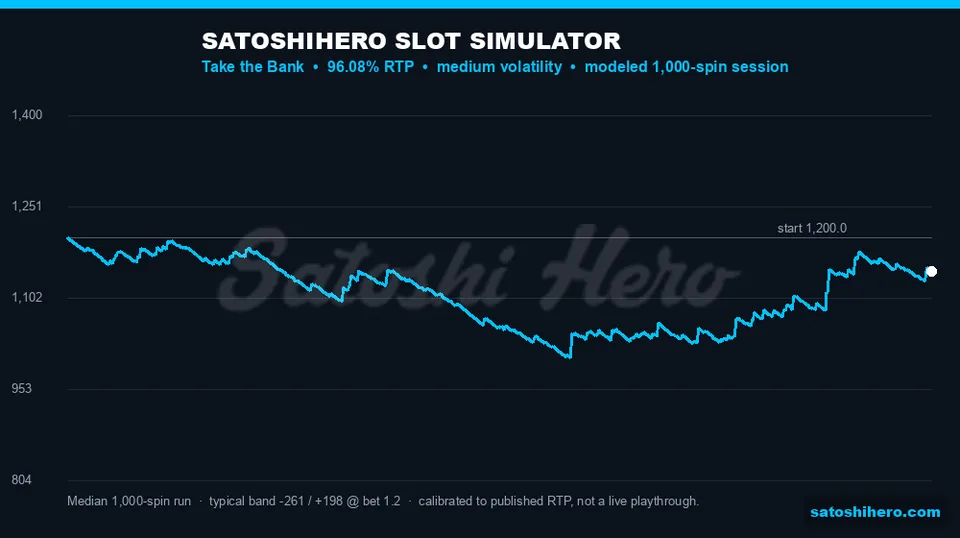
About one spin in four paid something. A feature-sized hit appeared roughly once every 50 spins, while a very big win appeared about once in 13,333 spins. The model describes outcome spread; it can’t predict your next session.
Fast Fact: A 225x cap means this is not built for huge thousands-x outcomes; the value sits in medium-volatility pacing and the countdown feature.
Our 100-spin session
My live demo matched that medium feel. I started at $1,000.00 and finished at $995.32, so the test ended $4.68 down. Free spins arrived immediately and paid $56.70, but the base game then gave most of it back.
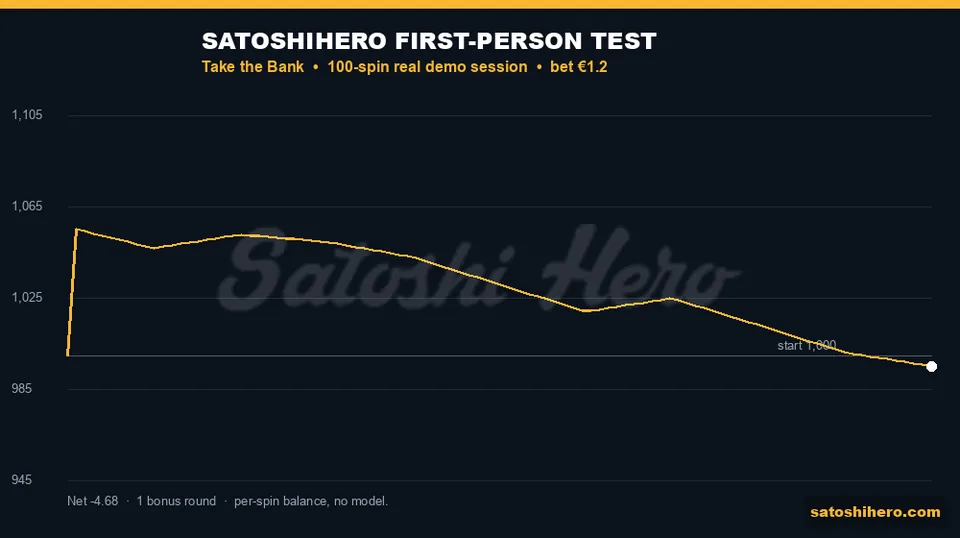
That doesn’t make the feature weak. It shows how a medium slot can combine a memorable hit with a slow slide afterward. You might like that if you prefer readable movement over huge dead stretches, but the capped upside limits the dream factor.
The 96.08% RTP is the operator’s published theoretical figure, and a single 100-spin live demo session doesn’t change or prove that return. Simulator results are modelled from the stated RTP, volatility and win cap. Bonus-buy returns can sit slightly differently from the base game by design.
Frequently Asked Questions About Take The Bank
How does the Master Bomb counter work in Take The Bank?
It counts down from 10 on every base-game spin. Each robber becomes a locked wild bomb, then all bombs turn into wilds when the counter reaches zero. The counter resets to 10, and those wilds clear on the next spin.
How do I trigger the free spins in Take The Bank?
Land three police cars on reels 2, 3 and 4. You get 15 free spins with 5, 7 or 10 moving wilds on every spin, and the Master Bomb counter pauses during the round.
What does the Buy Bonus feature cost in Take The Bank?
At a $1.20 bet, it costs $32.40 for 5 wilds, $60.00 for 7 wilds and $114.00 for 10 wilds. Those prices equal 27x, 50x and 95x the bet.
What are the RTP, volatility and maximum win in Take The Bank?
The RTP is 96.08%, the volatility is medium and the maximum win is 225x the bet. The game also uses 75 paylines on a 5×4 grid.
What did the 1000-spin simulator show for Take The Bank?
At a $1.20 bet, the median modelled session ended $54.60 down. The 5th to 95th percentile band ran from $260.70 down to $198.40 up, with a feature-sized hit about once every 50 spins.
How did my 100 live spins go in Take The Bank?
I started with $1,000.00 and finished at $995.32 after 100 spins at $1.20. The session ended $4.68 down after first-spin free spins paid $56.70.
Closing Thoughts
Take The Bank stands out because the countdown gives the base game a clear rhythm. Its main drawback is the 225x ceiling, which keeps the biggest-win dream smaller than many modern bonus-buy slots.

My Verdict
I’d play this when I want a readable heist slot with regular mechanical tension, not when I want a monster win chase. Expect small base-game movement, occasional feature spikes and a cap that keeps the ride controlled. The free spins can wake the game up, but the base game can still take money back.
I like how the first spin bonus gave the test a genuine story, then the later drift showed the risk honestly. I don’t like how expensive the 95x buy feels beside the maximum win. My cleanest takeaway is simple: the countdown works, but you still need strict limits.
Take The Bank gives you a tidy bank-heist slot with a useful test record, and SatoshiHero test notes are checked regularly when new play data changes the player-facing read.

Pros:
 Clear countdown: The 10-spin cycle makes base play easier to follow.
- Strong first feature: My free spins paid 47x and shaped the session.
- Readable layout: Reels, controls and counter stay clear on screen.
- Simple buy menu: Each tier links price directly to wild count.

Cons:
 Low ceiling: The 225x cap limits big-win ambition.
- Costly top buy: The 95x option can drain bankrolls fast.
- Base drift: My test gave back most of the early bonus.

Best For: Bankroll-aware players get the most from this slot when they like clear mechanics and medium pacing. The game fits you if you enjoy watching a feature build over 10-spin cycles. Huge-win hunters may prefer a slot with a higher cap.


































































Bets
All Bets
Game
Player
Date
Wager
Mult.Multiplier
Prize
 Luck of Panda: Bonus Combo
 Hidden
- 18:34:24
- 0×
- San Chong Baozha Blue: Bonus Combo
 mike_721
- 18:34:24
- 0×
- Sugar Rush Super Scatter
 Hidden
- 18:34:23
- 0.41×
- Blazing Stallion
 whodey39311
- 18:34:22
- 0×
- Luck of Panda: Bonus Combo
- Hidden
- 18:34:21
- 0×
- San Chong Baozha Blue: Bonus Combo
- mike_721
- 18:34:21
- 0.09×
- Blazing Stallion
- whodey39311
- 18:34:19
- 0.59×
- Luck of Panda: Bonus Combo
- Hidden
- 18:34:18
- 1.04×
- San Chong Baozha Blue: Bonus Combo
- mike_721
- 18:34:18
- 0×
- Luck of Panda: Bonus Combo
- josh1998
- 18:34:17
- 0×