

Pixel Paws
By pressing play, you agree that you are above legal age in your jurisdiction and that your jurisdiction allows online gambling.


Pixel Pets Power Up the Loaded Reel
Pixel Paws slot mixes pixel-art animals, variable ways, and AvatarUX’s Loaded Reel on a changing grid. This medium volatility game has a 95.84% theoretical RTP and 20,000x maximum win, starting with 1,024 ways before expanding to 16,807. It targets changing-grid fans who value features.
My 100 spins at $1 ended $25.20 down, with 35 paying spins and a $33.20 best hit. No bonus triggered, and I bought no feature, so unobserved mechanics come from game information. I started with $10,000 and used Fast Play; free and real play are available on SatoshiHero.
Key takeaways
- Best bonus: Standard $1 spins were my only tested mode, so I can’t honestly rank any bonus-buy tier for you.
- RTP / volatility: You get a 95.84% theoretical RTP paired with medium volatility.
- Max win: The 20,000x cap ends the round as soon as play reaches it.
- Risk note: My early 33.2x result didn’t stop the session finishing $25.20 behind.
- Bankroll note: The entry Hold & Win purchase deducts $60 immediately from a $1-stake balance.
Your own short run can look different. I think tested standard play offers a stronger baseline than an untested purchase.

Table of Contents
- How the Pixel Paws slot works
- Adjacent-reel wins
- Expanding win count
- Loaded Reel Rewards
- Trigger Zone timing
- Base-game rewards
- Theme & First Impressions
- Pixel-art animals
- Test presentation
- Symbol Values and Wilds
- Premium symbol pays
- Lows and specials
- Hold & Win Bonus
- Trigger and lives
- Bonus reward pool
- Bonus Buy Options
- Entry-level purchase
- Higher buy levels
- What 100 Spins Felt Like
- Early peak
- Slow decline
- RTP, Volatility & Our Test
- Simulator projection
- Our 100-spin session
- Frequently Asked Questions About Pixel Paws
- The Takeaway
How the Pixel Paws slot works
Wins need at least three matching symbols across adjacent reels, beginning on the leftmost reel. Pixel Paws slot uses variable ways rather than fixed paylines, so symbol positions can shift without breaking a valid combination. You should focus on copies per reel and board height, because both can increase the number of winning combinations.
Adjacent-reel wins
Matching symbols don’t need to occupy one row. However, a gap of one reel breaks the combination, even when the same symbol appears farther right. If two matching symbols land on reel one, three on reel two, and two on reel three, multiplication creates 12 winning ways. Several valid combinations can pay together, and the game adds those separate results.
That calculation explains why a return can exceed one paytable value. You aren’t watching a traditional line trace. From a design perspective, this approach rewards symbol density without making the board hard to read. Don’t mistake the ways counter for fixed paylines.
Expanding win count
The five-reel, four-row grid begins with 1,024 ways. Grid Expansion makes every reel taller, lifting the available total toward 16,807 variable combinations. The tested display kept its counters clear, even with the Loaded Reel beside the main board. You can still read the spin quickly, which I consider essential for a changing-grid game.
An extra manual spin after the test returned $0.80 through two small ways wins. Its screen showed 1,024 ways and reward arrows, but it isn’t part of my totals. You should read combined ways before judging a modest match.
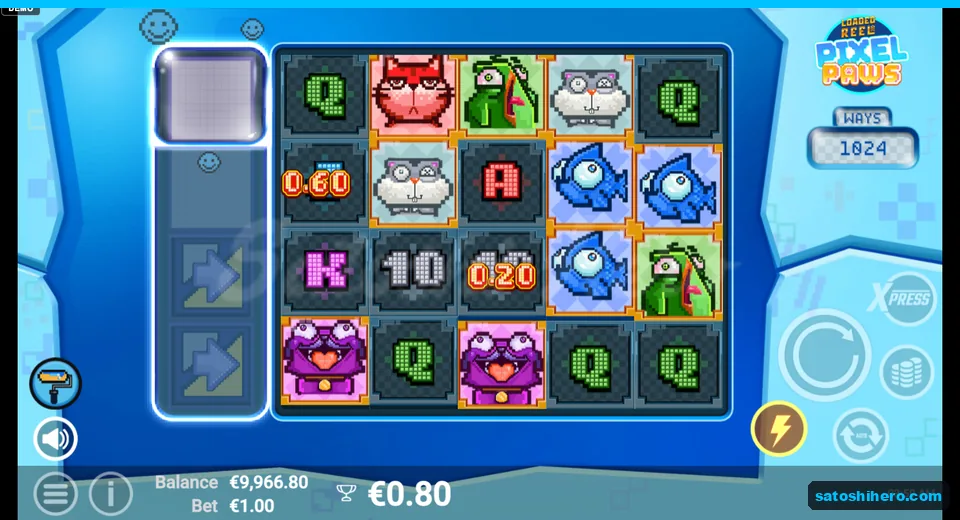

Key Number: Pixel Paws begins with 1,024 ways and can grow to 16,807. These are variable winning combinations, not fixed paylines.
Extra copies and board growth matter far more than fixed positions here. Once you read the reels that way, each result becomes easier to follow.
Loaded Reel Rewards
The Loaded Reel moves rewards upward until one enters the Trigger Zone and activates. Icons below that active area show possible future benefits, not prizes you’ve already received. You should watch the top cell during spins and cascades, because location decides whether anything fires.
Trigger Zone timing
A narrow column sits left of the five standard reels. Rewards and blank spaces advance from the bottom toward the top as reels spin and cascade. Only the reward entering the top Trigger Zone becomes active. Trigger Zone Expansion stretches that area downward by one position, creating another active cell.
Movement and activation are separate, and that distinction takes several spins to grasp. I like watching a useful icon climb, though visible rewards can look active too soon. You’ll learn faster by checking the active cell first.
Base-game rewards
According to AvatarUX’s game information, the base pool contains five reward types:
- Grid Expansion grows every reel upward by as many as three positions.
- Multipliers increase the win displayed on the screen.
- Low Pay Upgrade converts as many as five low symbols into stronger symbols.
- Wild rewards add burger substitutes to the main grid.
- Colossal Wild rewards place larger substitutes across several positions.
Hold & Win switches reward pools, so you shouldn’t assume base icons carry over unchanged. Mechanically speaking, the column connects grid growth, symbol improvement, and multiplication. That engineering adds personality, although its logic isn’t instant.

Smart Move: Watch the Trigger Zone rather than assuming every visible Loaded Reel icon has activated. Check the active cell before you judge what a spin delivered.
I found the base reward path understandable. Verify the Trigger Zone first, then read the resulting grid.
Theme & First Impressions
Pixel Paws slot uses bright pixel-art animals with clearly separated colors and shapes. You see a red cat, purple frog, green lizard, blue fish, and grey hamster against a vivid blue board. The compact starting grid keeps the cast readable, which matters once expansion rewards make the layout taller.
Pixel-art animals
A playful burger acts as the Wild among the animal symbols. Sharp retro outlines take priority over realism, giving every character an instantly recognizable silhouette. The animal concept won’t win awards for originality, but AvatarUX executes the pixel style with unusual consistency. You can identify most matches without staring at the paytable.

Lore: The animal cast echoes old handheld virtual-pet games, while the burger Wild keeps the theme deliberately playful.
Chunky shapes remain distinct when several copies crowd one reel, so added density doesn’t become visual noise. I appreciate that practical choice more than decorative animation. You’ll notice it when multiple ways resolve together.
Test presentation
My test opened on a five-reel, four-row board with the Loaded Reel on its left. Grid Expansion can raise the main board, while the separate reward column keeps its own upward path. I played at the $1 default stake with Fast Play enabled. Feature-heavy sequences can still take longer because cascades and reward movement need time to resolve.
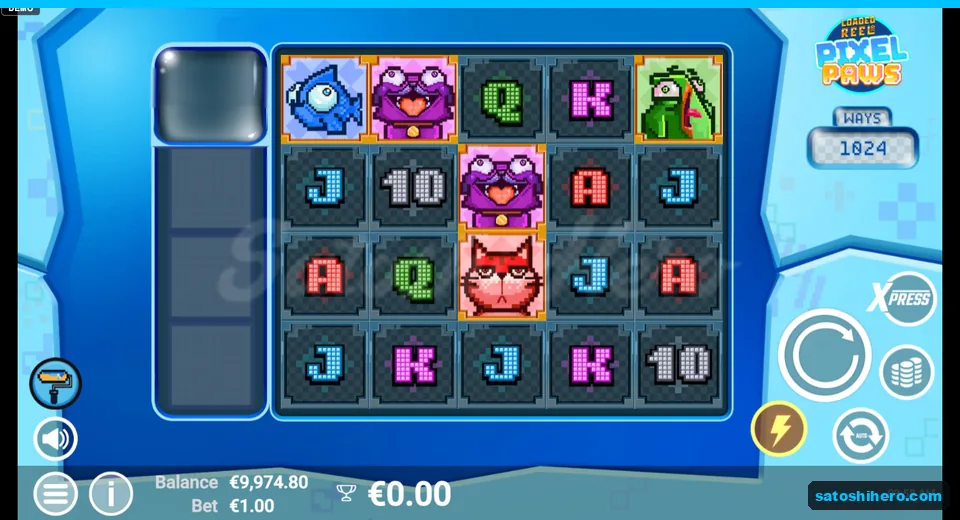
The settled board after spin 100 showed my $9,974.80 balance, $1 stake, 1,024 ways, and an empty Loaded Reel. I think that clean screen captures the interface well. You can see every important state quickly, and clear symbols help you follow the changing board.
Symbol Values and Wilds
The red cat is the highest regular symbol, while the burger Wild substitutes for everything except Coins. Every listed return uses total-bet multiples, and each paytable figure applies to one winning way. You can receive more than one way at once, so combined results can exceed a single listed value.
Premium symbol pays
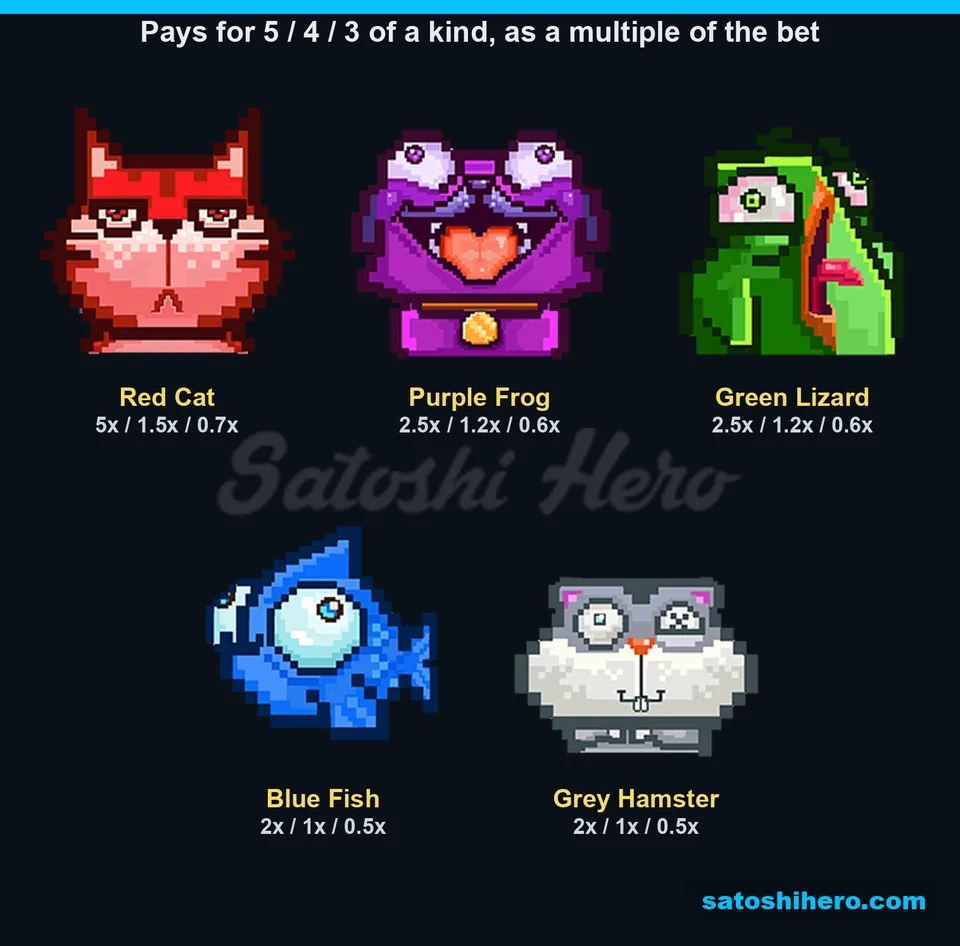
The five premium animals use three-, four-, and five-symbol values:
- Red cat: 0.7x for three, 1.5x for four, and 5x for five.
- Purple frog: 0.6x, 1.2x, and 2.5x.
- Green lizard: 0.6x, 1.2x, and 2.5x.
- Blue fish: 0.5x, 1x, and 2x.
- Grey hamster: 0.5x, 1x, and 2x.
The premium pay screen makes those three match lengths easy to compare. A 5x cat value looks modest alone, but repeated cats across several reels can create multiple paid ways. The game then adds those results. I prefer this transparent multiplication to oversized headline values that rarely connect.
If several copies create four valid cat paths, each receives the three-cat value before totaling. You should read the final amount as stacked combinations. That makes the result logic easier to audit.
Lows and specials
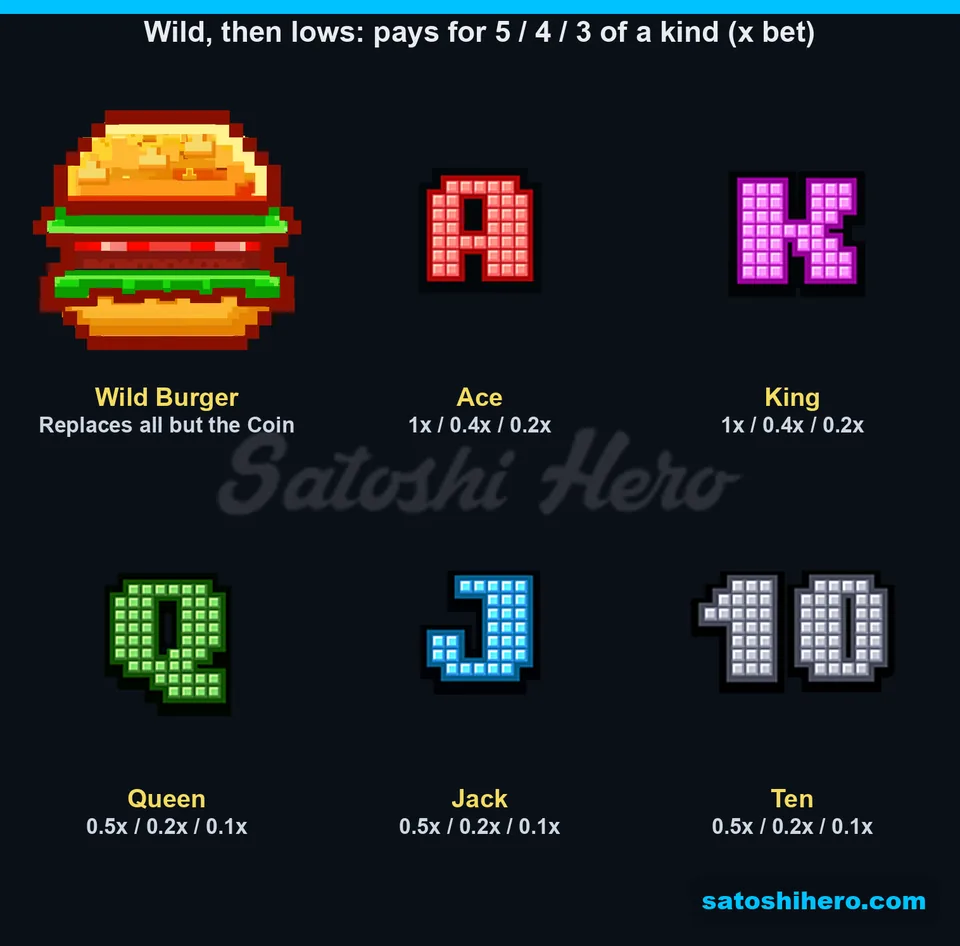
A and K pay 0.2x for three, 0.4x for four, and 1x for five. Q, J, and 10 return 0.1x, 0.2x, and 0.5x across the same match lengths. These lows can form several ways together, but many resulting returns still sit below your stake. I found those frequent small amounts more active than rewarding.
The burger Wild replaces everything except the Coin. Colossal Wilds arrive as larger substitutes through Loaded Reel rewards. Coins trigger and power Hold & Win rather than forming regular ways wins. Judge lows by combined ways, then treat each Coin as feature progress.
Hold & Win Bonus
Landing at least five Coins simultaneously triggers Hold & Win. The feature didn’t trigger during my recorded test, so the mechanics here come from the game information rather than firsthand activation. You should keep that evidence boundary in mind when weighing my comments. I like the structure on paper, but I won’t pretend I tested its payout rhythm.
Trigger and lives
All triggering Coins lock in place between spins. The feature starts with three lives, and an empty spin removes one life. Any new Coin resets the remaining count to three instead of adding a single life. Once every life expires, the accumulated amount pays.
Fresh Coins control value growth and feature length. One landing adds money while restoring your full runway. You can judge momentum through open spaces and the life counter together. I find that reset more meaningful than one extra spin.
Bonus reward pool
Only Coins and Loaded Reel rewards appear inside Hold & Win. One new reward enters the column each spin, then advances during cascades. The documented pool includes:
- Ordinary Coins and larger Colossal Coins.
- Coin Upgrade, which raises visible Coin values.
- Extra Lives, adding as many as three lives.
- Collect, where a treasure chest gathers all visible Coins.
- Collect and Multiply, where the chest also multiplies the gathered amount.
- Grid Expansion and Trigger Zone Expansion.
Ordinary and Colossal Coins use separate value ladders. My session never exposed their individual amounts. Mechanically, the feature combines locked-value growth with Loaded Reel timing. You’ll read it best by tracking new Coins, open cells, and reward position.
Locked Coins build the total while resets extend collection time. That interlock looks strong, but only a triggered round can show you how generous the pacing feels.
Bonus Buy Options
The cheapest purchase costs 60x and starts Hold & Win with five Coins already visible. I didn’t buy a feature or open the Xpress menu, so I won’t rank tiers I never played. You should view every purchase as concentrated bankroll exposure, not evidence of stronger profitability.
Entry-level purchase
At my tested $1 stake, the confirmed entry costs $60. That equals 60 standard $1 spins removed from your balance before the feature begins. Five Coins provide the starting board state, but they don’t guarantee a profitable result. I think the price feels substantial beside a standard session built from 100 spins.
Compare the $60 charge with your session budget. A buy compresses spending into one event, changing the shape of risk. You can lose control of pacing if you price it as one ordinary click.
Higher buy levels
The range continues through Bonus Max. Higher levels begin with more Coins and a larger machine, but I’m omitting prices that my test didn’t verify. No tier earns a recommendation without purchase evidence. You deserve a clear line between documented setup and actual play.
For contrasting reel and feature structures, compare the SatoshiHero guides to Hot to Burn – 7 Deadly Free Spins, Journey to the West, Hot To Burn Multiplier, Hot to Burn Extreme, and Hot to burn. Their more traditional layouts provide a useful counterpoint to the changing grid and Loaded Reel here.

Red Flag: At a $1 stake, the cheapest buy removes $60 from your balance immediately. Set a separate buy budget instead of treating it like one normal spin.
Standard play spreads spending across more decisions and matches my tested experience. Choose it when you value slower exposure, because the untested higher tiers don’t justify confident claims.
What 100 Spins Felt Like
My $1 test produced one strong early hit before sliding to a $25.20 loss. Spin 4 returned $33.20, but the remaining run couldn’t protect that early lead. You should read the session as one observed path, not a typical promise. I found the gradual decline more revealing than the isolated peak.
Early peak
Autoplay began with $10,000 at a $1 stake. Spin 4 paid $33.20, equal to 33.2x, and pushed my balance to roughly $10,030. The sequence lasted about 18 seconds, far longer than every other logged spin. Cascades and reward movement made that result feel like the session’s clear centerpiece.
One sizeable return can dominate a short run without deciding it. I felt ahead after four spins, yet that lead misrepresented the next 96. You shouldn’t treat an early spike as secured money. Duration can signal activity without guaranteeing a huge payment.
Slow decline
From the early peak, my balance drifted down to $9,974.80. The final record contained:
- $100 wagered across 100 spins.
- A $25.20 net loss.
- 35 paying spins.
- A $7.40 second-best result on spin 61.
- A $5.10 third-best result on spin 54.
- No named bonus trigger.
Many paying spins returned less than the $1 stake. Those small hits kept the counter moving, but the run depended heavily on my 33.2x result. Without it, the balance path would have felt much harsher. I didn’t count several later manual spins used to capture the base-game image.
Pixel Paws slot felt most honest here. You can see many paying outcomes and still finish behind, because frequency says nothing about size. A paid spin can reduce your balance.
RTP, Volatility & Our Test
According to AvatarUX’s game information, Pixel Paws slot combines a 95.84% theoretical RTP, medium volatility, and a 20,000x maximum win. Reaching that cap ends the round immediately. Official mathematics, modeled outcomes, and my recorded session answer different questions, so you shouldn’t blend them into one forecast. I think this separation gives you more useful risk context than any single headline figure.
Simulator projection
The SatoshiHero Slot Simulator modeled 1,000 spins at $1. Its median run finished $41.80 down, while the central 90% ranged from $206.20 down to $145.50 up. Data from the SatoshiHero Slot Simulator put the paying-spin rate at roughly 25%, with a feature-sized result appearing about once per 50 modeled spins. A very large result appeared about once per 12,500 modeled spins.
Those frequencies describe a distribution, not a schedule. They aren’t promises or countdowns, and your session doesn’t move closer after each miss. The curve showed gentle downward drift within a broad range. I think that spread matters more than the median.
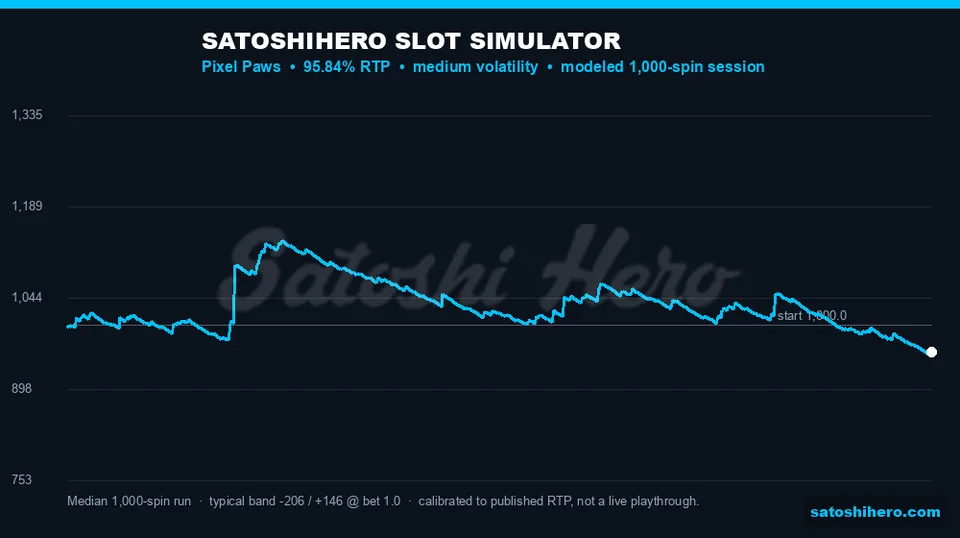
Use the model to judge swing size before setting a budget. Don’t read one-in-50 as a feature due on spin 50. Its strongest lesson is uncertainty.
Our 100-spin session
I started with $10,000 and finished at $9,974.80 after losing $25.20. My 35 paying spins created a 35% observed rate, above the model’s approximate 25%. The largest result reached $33.20, and no named bonus triggered. Despite more frequent pays, many returned less than $1.
That comparison separates hit frequency from profitability. My session paid more often than modeled, yet lost one quarter of $100 wagered. You shouldn’t treat 100 spins as proof against theory. The run shows why return size matters beside hit count.
The balance graph rises early, then declines toward $9,974.80. That shape matches one exciting sequence followed by smaller outcomes. Use both datasets as risk context, since neither identifies your next reward.
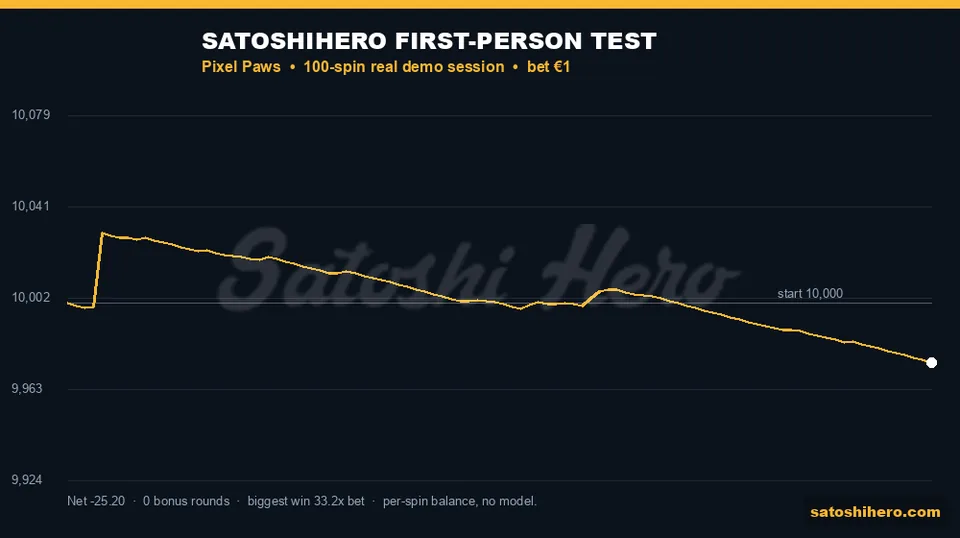
The theoretical RTP is the operator-published return, the simulator is a model, and my 100-spin test is one observed session. A single session doesn’t alter theoretical RTP, while estimated event frequencies never guarantee timing. Per-bonus returns can differ slightly from the base by design.
Frequently Asked Questions About Pixel Paws
How does the Loaded Reel work in the Pixel Paws slot?
The left-side column moves rewards upward until they reach the top Trigger Zone. Base rewards include Trigger Zone Expansion, Grid Expansion, multipliers, Low Pay Upgrade, Wilds, and Colossal Wilds. Visible rewards below the active area haven’t triggered, so you should watch the top cell.
What triggers Hold & Win in the Pixel Paws slot?
At least five Coins must appear simultaneously. Those Coins lock, the feature starts with three lives, and every new Coin resets the count to three. My recorded test didn’t trigger it, so this answer comes from game information rather than my play.
How many ways to win does Pixel Paws slot have?
The five-reel, four-row board begins with 1,024 ways. Grid Expansion can raise that total to 16,807 variable ways. These aren’t fixed paylines, and you should count matching copies across adjacent reels.
Can you buy the bonus in the Pixel Paws slot?
Yes. The confirmed entry purchase costs 60x, or $60 at the tested $1 stake, and starts Hold & Win with five Coins. Higher levels begin with more Coins and a larger machine, but I purchased and ranked none of them.
What does the Pixel Paws 1,000-spin simulator show?
Data from the SatoshiHero Slot Simulator produced a $41.80 median loss and a central range from $206.20 down to $145.50 up. Its paying-spin rate sat near 25%, with a feature-sized result around once per 50 modeled spins. Those figures don’t guarantee your timing.
How did the Pixel Paws slot 100-spin test go?
My balance moved from $10,000 to $9,974.80 after 100 spins at $1. I lost $25.20 despite 35 paying spins, while my $33.20 top result arrived on spin 4. No named bonus triggered during the counted session.
Which RTP, volatility, and maximum win apply to Pixel Paws?
Pixel Paws has a 95.84% theoretical RTP, medium volatility, and a 20,000x maximum win. Reaching the win cap ends the round. Your short session can vary sharply without changing that theoretical return.
The Takeaway
Pixel Paws stands out through a Loaded Reel connecting grid growth, upgrades, Wilds, and multipliers. Visible reward icons take time to understand, while many base wins return less than your stake.

My Call
Play standard spins if changing ways and feature progression hold your attention. Expect modest base returns and occasional longer sequences. Keep bonus buys separate from your normal budget.
I like how the reward column links mechanics without cluttering the grid. I don’t like how heavily my run relied on one $33.20 hit after 35 spins paid. Missing Hold & Win limited my firsthand judgment.
The Pixel Paws slot details are checked regularly, while my results remain one fixed test. You should use them as risk context, not a prediction.

Pros:
 Variable ways: Grid growth raises combination potential while preserving readable symbol paths.
- Linked rewards: The Loaded Reel connects upgrades, expansion, Wilds, and multipliers coherently.
- Clear symbols: Strong colors make crowded ways wins easier to follow.
- Honest pacing: Standard spins let you control spending more gradually than bonus buys.

Cons:
 Learning curve: Visible rewards can look active before reaching the Trigger Zone.
- Small returns: Many paying spins can still return less than your stake.
- Untested bonus: My session never triggered Hold & Win for firsthand payout insight.

Best For: Changing-grid fans and technically curious players can appreciate how rewards interact. You’ll get more from it by tracking ways, reward position, and return size.



































































Bets
All Bets
Game
Player
Date
Wager
Mult.Multiplier
Prize
 6 Jokers
 kotakota9180
- 04:20:29
- 4.89×
- Wild Buffalo: Megaways
 mike_721
- 04:20:28
- 0×
- Mr. Crystalman: Hold 'N' Link
 Hidden
- 04:20:27
- 0.6×
- San Chong Baozha Blue: Bonus Combo
- mdp0fxo
- 04:20:26
- 0×
- 6 Jokers
- kotakota9180
- 04:20:22
- 0×
- Elephant's Gold: Bonus Combo
- Hidden
- 04:20:22
- 0×
- 6 Jokers
- kotakota9180
- 04:20:20
- 0.42×
- Galaxy Glitter
- nina87
- 04:20:19
- 0×
- 6 Jokers
- kotakota9180
- 04:20:18
- 0.17×
- San Chong Baozha Blue: Bonus Combo
- mdp0fxo
- 04:20:17
- 0.35×